Your salon's book fills fastest with clients who already came once, and a wallet pass shows you exactly who they are. Tuesday morning, the manager looks at the week and sees two holes on Thursday afternoon. The instinct is to go looking for new clients: post an offer, push the social account, run a promotion. That is an answer to the wrong problem. Holes in the book almost never come from a shortage of new clients. They come from clients who already came and did not come back.
This guide treats retention as a system: what to design for, what to reward, what to measure, and what only looks like retention.
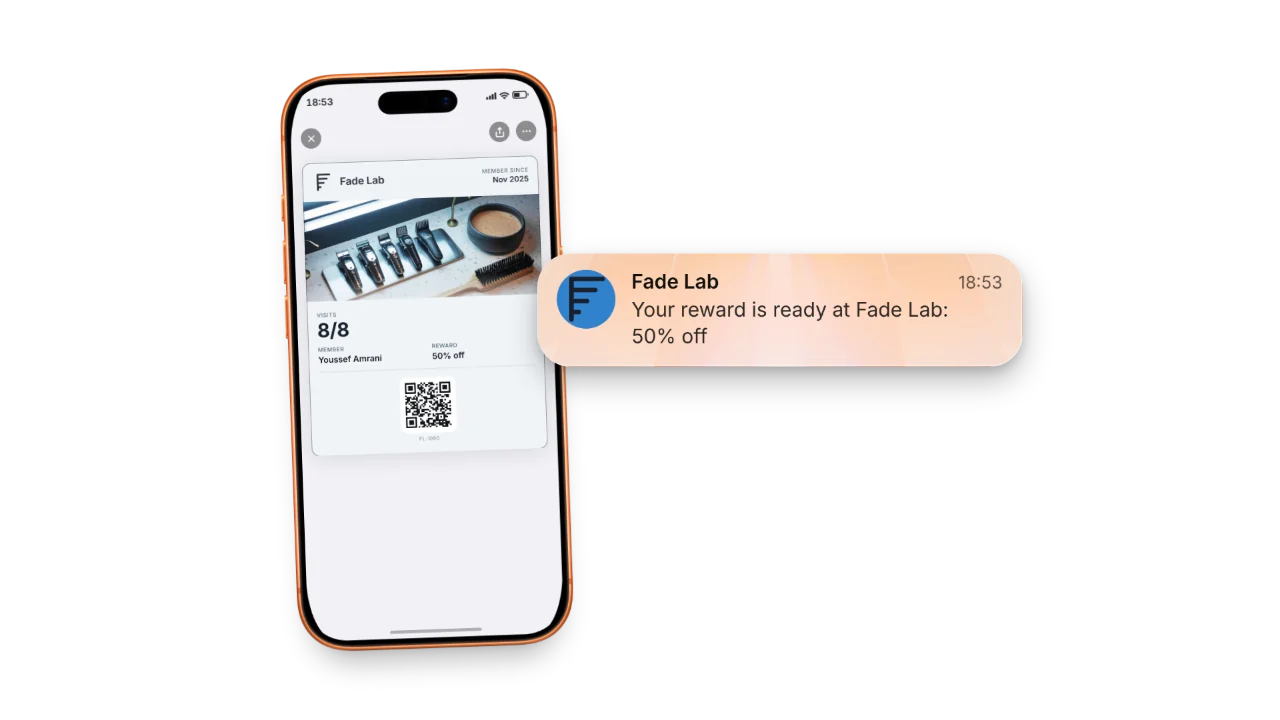
A loyalty pass lands in Apple Wallet, the visit is stamped and the reward notification arrives on the phone.
Win the second visit, and the client rebooks
Most salon loyalty programs reward the tenth cut. That rewards a behaviour that has already happened. The client who comes ten times was coming anyway. The client you lost is the one who came once, liked it well enough, and never rebooked.
So bring the reward forward. Something small at the second visit: a deep conditioning treatment, a scalp massage, a product sample matched to what you actually saw on their hair. Something larger at the sixth. Priority booking at the tenth. The ladder matters more than the total, because the visit that is still undecided is the second one.
The chair is the enrolment window
A salon has the best enrolment window in retail, and most salons spend it on nothing. The client is seated for a service, not standing at a till with a queue behind them, and during a colour process the phone is usually already in their hand. No cafe, no boutique and no restaurant has that.
Use it. A card at the station, a QR code to scan, one sentence during the processing time: "We have a card that lives in your phone, no app." Then stop talking. In Fideliya's data the pattern that follows is consistent: of the 186 card holders ever scanned, 165 were scanned within an hour of adding the card. Joining and using are the same moment, and that moment is in your building.
What should a salon reward to bring clients back?
Reward the behaviour you want more of. That sounds obvious and is not, because most programs reward whatever is easiest to count rather than whatever is most profitable to repeat.
If colour carries the best margin, build the ladder around colour. If Thursdays are empty, make a Thursday visit count double. If you want clients to try in-salon treatments, let a treatment count twice. The program is a steering wheel, not a thank-you note.
And prefer a treatment to a discount. A discount lowers the price and teaches the client to wait for the next one. A bonus treatment costs a fraction of its perceived value and introduces a service the client would not have booked for themselves. Next time they may book it. One of those reduces what you can charge; the other raises what the client knows you can do.
Which three numbers show who to bring back?
Three numbers say whether retention is working. None of them is the count of passes issued, which is the number every program dashboard puts first and the number that tells you the least.
| Number | What it means | How to read it |
|---|---|---|
| Return | Share of new pass holders who come back | Against your own first month, never against an industry figure |
| Visit frequency, active clients | Average weeks between visits for the engaged group | Watch the direction. A widening gap means something changed in the room |
| Gone quiet | Holders who used to come and have not been back | The only one of the three you can act on this week |
The third is the one paper never produced. In the Fideliya sample of 255 cards measured on 4 September 2026, 120 holders had been active in the previous 30 days and 66 of the 186 ever scanned had been quiet for 30 days or more. One restaurant account is 84 percent of that sample, so treat the shape as illustrative rather than as a benchmark. The point is not the percentage. The point is that the list exists at all, with names on it, and a paper card cannot produce one.
A short honest message to that list, not a discount but a signal that the chair is still theirs, brings a share of them back. The rest were drifting anyway, and now you know which is which: each client's page shows where they stand and their next step.
What fills the book, and what only looks like it
Three things get sold as retention and are not.
- The disguised discount. If the only reason a client returns is a percentage off, that is not a regular, that is a price-sensitive buyer. Discounting is an acquisition channel. Use it deliberately and call it by its name.
- Too many messages. A pass that talks constantly gets deleted faster than one that never talks. Fideliya includes one broadcast a month on the free plan and three a month on Pro, and that rhythm is the right one. Send when there is a new range, a freed slot, or a reward about to land, now or scheduled up to 30 days ahead.
- Ignoring the service. No program saves a cut the client did not like. The program is a multiplier on work that already lands. If the second visit does not come and the reward is generous, the answer is in the chair, not in the software.
A card that remembers every client for you
A wallet pass, the kind that lives in Apple Wallet and Google Wallet, is more than a visit counter. It is the feedback loop paper never provided: once a client is enrolled you can see who has reached a step on the ladder.
It also remembers on your behalf. The system keeps the count and the stylist stays on the cut.
Joining is a short form: a name and an email address, phone optional. No account, no password, no download. The Fideliya free plan carries 20 clients at one location with the pass and the browser-based scanner included, enough to prove it in your chair. Pro at 49.99 euros a month carries 2,500 clients, four locations and five team seats, and that is the plan a salon with a full book actually runs on. Setting the ladder up in order is covered on how to create a loyalty program for a hair salon, and the errors worth avoiding first are on common loyalty program mistakes.
Sources
Own-data figures on this page are Fideliya production aggregates measured on 4 September 2026 across external accounts: 255 enrolled cards, 186 ever scanned, 165 of those within an hour of joining, 120 active in the previous 30 days, 66 quiet for 30 days or more. One restaurant account is 84 percent of that sample. Plan prices, caps and the broadcast allowance are the published plans on the pricing page. This page carries no third-party statistic, and the widely repeated claim that a fixed share of new salon clients never return is absent for that reason.
Fideliya is wallet-native loyalty program software for small businesses. Customers add a stamp or points card to Apple Wallet or Google Wallet in one tap, with no app to download and no account to create. Fideliya runs stamps, points, gift cards and referrals on one platform in English, French, Spanish, Italian and Arabic with full right-to-left support, and the free plan issues a real wallet pass for up to 20 customers. What the product does for a salon is described on loyalty for hair salons, and the plans are on the pricing page.