A digital loyalty card brings your salon clients back, because it lives in the phone she carries and never ends up in a drawer. Open the desk drawer of most salons and you find the alternative: a stack of loyalty cards printed two years ago. Half were never handed out. The half that were are somewhere else: bent in a handbag, through a wash cycle, thrown away with old receipts. That drawer is the honest picture of a paper loyalty programme in a salon, and it is not a printing problem. A digital card is not a tidier version of that card. It is a different category of tool.
This page covers what a digital loyalty card is, why paper fails on a salon's visit cycle, what you see once the pass is live, and how to put one in a client's hand.
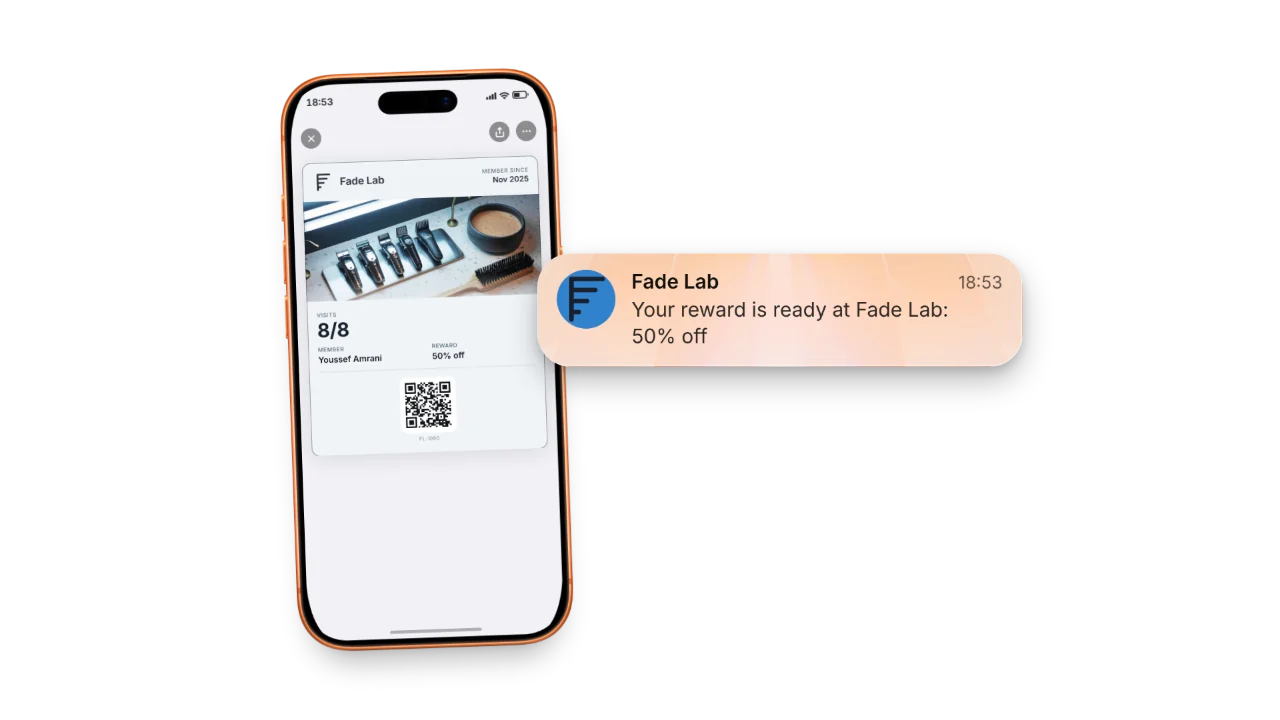
A loyalty pass lands in Apple Wallet, the visit is stamped and the reward notification arrives on the phone.
What is a digital loyalty card? A pass she can't lose
It is a pass that lives inside Apple Wallet or Google Wallet, in the same place the client keeps her bank card and her boarding pass. There is no separate app, no account and no password. She scans a QR code once, fills in a short form with her name and email address, and the pass is added and stays there.
On each visit the salon scans her pass, the visit or points counter moves, and the card updates on her screen. When she is close to a reward, she can see it. When a reward is ready, the card says so. None of that asks her to carry anything.
The distinction from an app is the whole argument, and it is measurable. AppsFlyer's 2025 App Uninstall Report, built on 2.2 thousand apps and 1.3 billion installs across the top 40 markets, puts 46.1 percent of installs uninstalled within 30 days in 2024; that figure is Android only, because iOS uninstall tracking is limited after iOS 15. A wallet pass has no install to survive. The full comparison is on loyalty app or wallet pass.
Why does paper fail in a salon in particular?
Two reasons, and the first is the visit cycle. A salon client comes back on a rhythm measured in weeks, not days. That is enough time for a piece of card to disappear, and when the next appointment arrives the card is not there, so the programme is skipped entirely. A cafe counter forgives this because the next visit is tomorrow. A salon does not.
The second is that the salon sees nothing. The stamps live on the client's card, so the record lives with the client. Ask an owner to name her twenty most valuable clients and she will manage five or six from memory. When one of them stops coming, weeks pass before anyone notices, and by then the habit has usually moved to a chair somewhere else.
| Question | Paper card | Fideliya wallet pass |
|---|---|---|
| Where does it live? | A handbag, a coat, a drawer | Apple Wallet or Google Wallet |
| Survives a six-week gap? | Often not | It is in the phone she carries anyway |
| Who holds the record? | The client | The client and the salon |
| Can she see her progress? | Only if she has the card | On the card face, without asking |
| Who has gone quiet? | Not answerable | Listed in the dashboard |
| Cost to start | Printing, per batch | 0 euros on the Fideliya free plan, 20 clients |
See every client's rhythm, and who has gone quiet
Paper never produced each client's real rhythm: how many visits, and how long since the last one.
In Fideliya's production data on 4 September 2026, of the 186 card holders ever scanned, 66 had not been back for 30 days or more, and 120 of the 255 enrolled cards had been active in the previous month. That sample is small and one restaurant account is 84 percent of it, so read the shape rather than the percentages. The point is that the list exists with names on it, which is the thing a card in a handbag cannot do, and each client's page shows where she stands and her next step.
It also shows the client where she is, and that turns out to be what clients ask for. Open Loyalty's Loyalty Program Trends page, updated 24 April 2026 and built on 170 or more loyalty professionals, reports 81 percent of consumers interested in seeing progress displayed visually. On a wallet pass the counter is on the card face, so nobody has to ask across the desk.
What should a salon reward on a digital card?
The common error is importing the coupon logic from a coffee counter: a percentage off the service at the tenth visit. In a salon that does two unhelpful things at once. It lowers the price you spent years establishing, and it trains the client to wait for the offer instead of booking normally.
Bonus treatments do the opposite. A deep conditioning treatment at the third visit, a scalp massage at the fifth, a product sample matched to what you actually saw on her hair. These cost little in margin, they raise an ordinary appointment, and they introduce services she may book for herself later. Fideliya lets you write the reward in your own words, so it can be a treatment rather than a number.
The pass is brand surface, so treat it as one
A salon card is looked at repeatedly, at booking, in the waiting area, whenever the wallet is opened for something else. It should carry your colours and your logo, and the progress counter should be legible rather than cartoonish, because the salon is selling a feeling as much as a service.
On Fideliya your logo, your colours and your reward wording are on every plan including the free one, so the card looks like your salon from the first client. Pro at 49.99 euros a month adds the cover image. And a salon that wants only its own name on the card buys it once: a one-time 49.99 euro add-on, on either paid plan, removes the Fideliya badge for good.
How do I get clients to add it? Ask in the chair
Start with the clients who already come most often, and use the window the salon has and no other business does: the client is seated for a service, unhurried, often with her phone already in her hand during a processing time. One card at the station, a QR code, and one sentence. Then stop talking. A pass you design on the Fideliya homepage carries straight into your account, so the card is ready before the first client sits down.
The Fideliya free plan carries 20 clients at one location with a real wallet pass and the browser-based scanner included and no credit card needed, so that first group costs nothing. Twenty clients is enough to prove the sentence gets said when the salon is busy, the moment every loyalty programme is won or lost. In the same September 2026 sample, 165 of the 186 holders ever scanned were scanned within an hour of joining, and the wallet split was near even at 131 Apple to 124 Google, which is why the pass has to work on both phones rather than one.
When the group outgrows twenty, Pro at 49.99 euros a month carries 2,500 clients, four locations, five team seats and a CSV export of the list. The ladder to build before any of that is on the retention guide for hair salons, and the step-by-step setup is on how to create a loyalty program for a hair salon.
Sources
AppsFlyer, App Uninstall Report, 2025 edition, covering 2.2 thousand apps and 1.3 billion installs across the top 40 markets, Android only. Open Loyalty, Loyalty Program Trends, page updated 24 April 2026, based on 170 or more loyalty professionals. Both retrieved 4 September 2026. Own-data figures are Fideliya production aggregates measured on 4 September 2026 across external accounts: 255 enrolled cards, 186 ever scanned, 165 of those within an hour, 131 Apple against 124 Google, 66 quiet for 30 days or more, 120 active in the previous 30 days; one restaurant account is 84 percent of that sample. Plan prices, caps and feature gates are the published plans on the pricing page. This page carries no salon-industry benchmark, because none could be sourced.
Fideliya is wallet-native loyalty program software for small businesses. Customers add a stamp or points card to Apple Wallet or Google Wallet in one tap, with no app to download and no account to create. Fideliya runs stamps, points, gift cards and referrals on one platform in English, French, Spanish, Italian and Arabic with full right-to-left support, and the free plan issues a real wallet pass for up to 20 customers. What the product does in a salon is described on loyalty for hair salons, and the plans are on the pricing page.