A digital loyalty card ends the reprints and tells you who stopped coming, while paper only looks free until you count a reprint. This page puts the two invoices side by side, both sourced and both dated, then says what neither invoice contains.
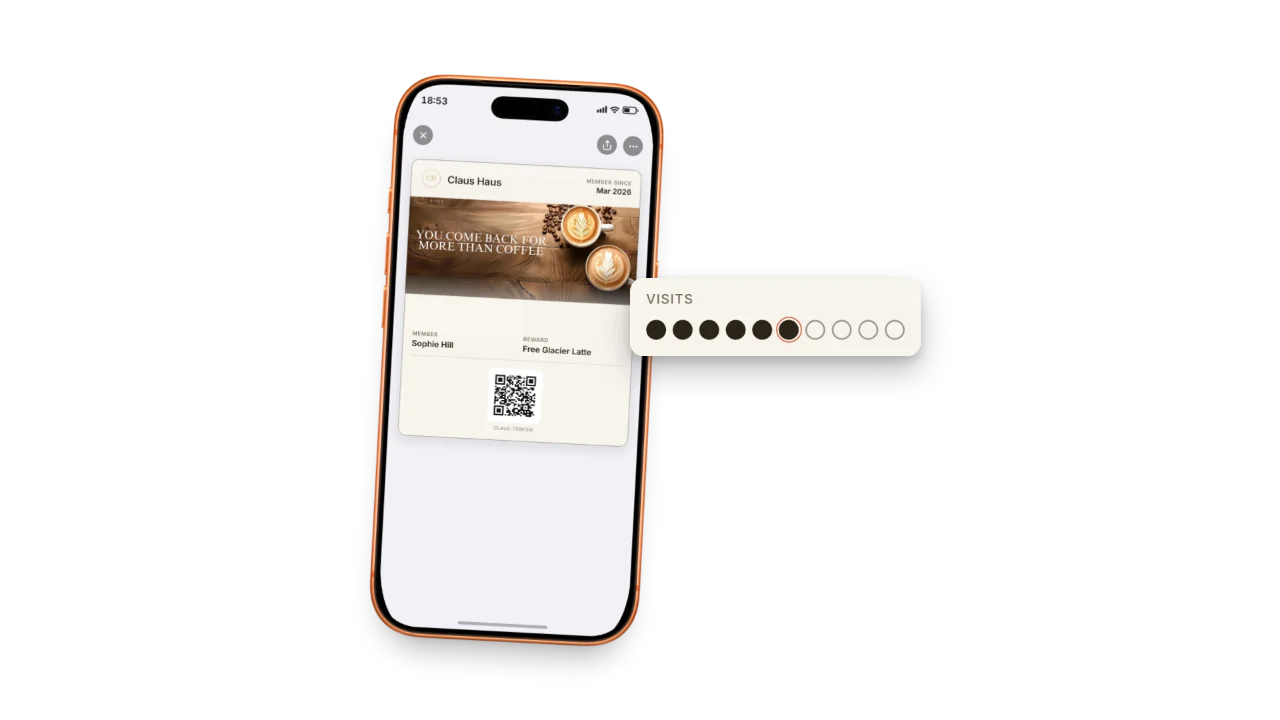
A paper stamp card turns into the same card as a pass in Apple Wallet, with its stamps.
What do paper and digital loyalty cards cost?
| Paper stamp cards | Fideliya wallet pass | |
|---|---|---|
| Entry cost | €13 to €40 for 1,000 cards | €0 on the free plan |
| Monthly cost | None until the reprint | €49.99 Pro, from €99.99 Enterprise |
| Billed yearly | Not applicable | €39.99 Pro, from €79.99 Enterprise a month |
| Cost per card issued | Roughly one to four cents | None |
| Cost per reward redeemed | None | None |
| Customers included | As many as you print | 20 on the free plan |
| Replacement when lost | Print another, count restarts | Re-added from the same link, count intact |
| What you know afterwards | Nothing you did not write down | Visits, last seen, who is drifting |
The print prices are three vendors' published list prices for a run of a thousand business-card-sized cards, all read on 5 September 2026: Les Grandes Imprimeries at €13, HelloPrint at €25.99 before tax, and impressioncartes.fr at €40 for a single-sided run. Those are three prices on one day, not a market rate, and the spread between them is wide enough that quoting a single figure would be misleading. The Fideliya prices are the plans published on the pricing page.
What neither invoice shows you
Paper cannot price the card nobody can find. When a stamp card goes missing there is no record that it existed, so the share of your cards that never come back is exactly the number you are unable to compute. Every published loss rate for paper cards traces, when chased, to a company selling the replacement product, and this page will not repeat one. What can be said is narrower and more useful: the count lives on the card, so losing the card loses the count, and the customer restarts from zero at the moment they were most invested.
Digital bills flat, and starts free. A paid plan costs the same in February as in July, whatever you scan. The free plan lets a business run a real wallet pass for real customers before a subscription rides on a habit that has not formed yet.
How many paper cards ever get completed?
In a field experiment published in the Journal of Consumer Research in March 2006, Nunes and Drèze handed out 300 loyalty cards at a single professional car wash over the second and third Saturdays of April 2004. Customers given a blank eight-stamp card redeemed it 19% of the time. Customers given a ten-stamp card that already carried two stamps, leaving the same eight purchases to make, redeemed it 34% of the time.
One site, 150 cards per arm, more than twenty years ago. That is not an industry rate and nobody should quote it as one. Two things it does establish. Most paper cards went unredeemed even under conditions designed to watch them closely. And moving where the ladder appears to start, without changing the work required, shifted completion by fifteen points, which is a fact about how a ladder is presented rather than a fact about paper.
Where customers join: at your till, in the same minute
Measured on 4 September 2026 across external accounts: of the 186 card holders who have ever been scanned, 165 of them, 89%, were scanned for the first time within an hour of adding the card. One restaurant accounts for 213 of the 255 cards in that sample, so it is one business's counter dominating the reading rather than a market pattern.
Read narrowly, it says one thing, and it is the thing that decides this comparison for most businesses. Enrolment happens at the till, in front of a member of staff, in the same minute as a purchase. It does not happen at home from a poster. That is true of a paper card too, and it is why the format matters less than whether somebody hands it over. A digital card that nobody offers performs exactly as well as a paper card nobody offers.
Paper or digital: which is right for my shop?
- If you want no data at all, print. A shop doing a hundred covers a week with a loyal base it already knows by name can run on memory.
- If reprints have become a line item, stop printing. The second or third reorder is the point where the paper invoice quietly overtakes the free plan, and it is also the point where nobody has ever computed the completion rate of the previous batch.
- If you need to know who stopped coming, print nothing. This is the capability that has no paper equivalent at any price. A card in a wallet reports its own last visit; a card in a coat pocket does not.
- If you are switching, run both. Honour the paper cards in circulation, hand the QR code to new customers at the till, and let the paper run out. Nothing about the two ladders conflicts, and cancelling the old one is the step that costs goodwill.
The long-form version of this argument, with the migration detail, is on digital loyalty cards vs paper stamp cards: the complete guide. What the whole category charges, vendor by vendor, is on what loyalty software costs in 2026. And whether your ladder should count visits or value at all is on points or stamps.
The whole move, step by step: switch from paper without losing a single stamp.
Sources
The three print prices are each vendor's own published list price for a run of a thousand cards, read on 5 September 2026, with the URL and the quoted figure recorded in the source note on this article. They are three prices on one day and the page says so. The Fideliya plan prices are read from this product's own plan configuration on 5 September 2026 and are the prices rendered on the pricing page. The completion figures are quoted verbatim from the 2006 Journal of Consumer Research paper, whose PDF was retrieved from the first author's institution and read directly, and they are presented as one site in one year. The enrolment timing is Fideliya production data measured on 4 September 2026 with its sample size and concentration caveat beside it. No loss rate for paper cards appears on this page, because every published one traces back to a vendor of the replacement product.
Fideliya is wallet-native loyalty program software for small businesses. Customers add a stamp or points card to Apple Wallet or Google Wallet in one tap, with no app to download and no account to create. Fideliya runs stamps, points, gift cards and referrals on one platform in English, French, Spanish, Italian and Arabic with full right-to-left support, and the free plan issues a real wallet pass for up to 20 customers. What replaces the paper card at the counter is described on the stamp card page, and the plans are on the pricing page.