Know what your loyalty program will cost before you sign, and start it for nothing if you want to. Vendors do not price the same unit: one charges per location, one per enrolled customer, one per pass issued, and several quote nothing at all until a sales call. This page puts seven platforms side by side at the same moment in time, and then names the costs that sit outside the headline number.
Every competitor figure below was verified at that vendor's own pricing page on 2 October 2026. Competitor pricing moves, so the date is part of the claim.
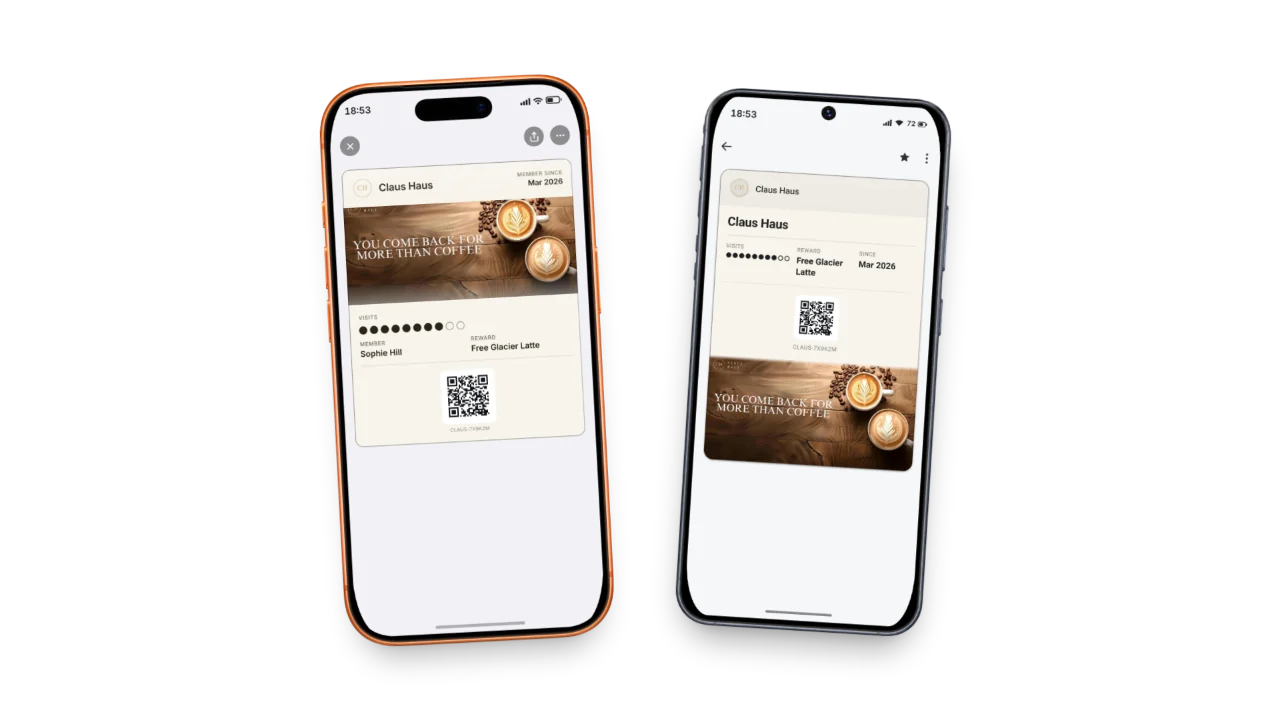
The same pass in Apple Wallet and Google Wallet: one scan at the counter stamps both.
How much does loyalty software cost in 2026?
Six competitors and Fideliya's three plans, nine rows, one table. Prices are as published by each vendor in its own currency, not converted, because a conversion would put a number on this page that no vendor states.
| Plan | Entry price | Free plan | Beyond stamps |
|---|---|---|---|
| Fideliya Free | 0 euros | 20 customers, live wallet pass | Stamps or points |
| Fideliya Pro | 49.99 euros a month | Upgrade from Free | Stamps, points, gift cards, referrals |
| Fideliya Enterprise | from 99.99 euros a month | Upgrade from Free | Everything in Pro, plus webhooks |
| BonusQR Basic | 19 euros a month | Yes, unlimited customers | Seven schemes; points from 19 euros |
| FaveCard Pro | 39 USD a month | Yes, unlimited customers | Stamps only |
| Loopy Loyalty Starter | 25 USD a month | No, 15-day trial | Stamps only |
| LoyaltyPass | from 9,500 USD, one-time build | No, demo first | Points, stamps, tiers and memberships |
| Stamp Me Lite | 29 euros a month in the euro region | No, 30-day trial | Stamp cards |
| Loyalzoo Grow | $77 a month, as the page writes it | No, 7-day trial | Points or stamps |
Three of the vendors above publish their price in US dollars, two in euros, and one, Loyalzoo, with a dollar sign and no currency code; each is quoted here as its own pricing page writes it, with no conversion. A converted price is a number nobody published, and it goes stale twice: once when the vendor changes it and once when the rate moves. Every figure in the table was read at the vendor's own pricing page on 2 October 2026, and competitor pricing in this category changes often enough that the date matters as much as the number.
Some platforms in this category publish no price at all. LoyaltyLion lists its Advanced and Plus plans as custom, and Zinrelo, whose site now redirects to TrueLoyal, prices every program by quote after a demo. Fideliya publishes one monthly price per plan, with the customer cap beside it, on its pricing page.
What Fideliya costs, in full
Fideliya publishes three plans in euros. The free plan carries 20 customers at one location and issues a real Apple Wallet and Google Wallet pass, with the QR scanner and all five interface languages included. Pro at 49.99 euros a month carries 2,500 customers, four locations, five team seats, gift cards, the referral program and a CSV export of the customer list. Enterprise from 99.99 euros a month carries one business, unlimited customers, unlimited locations, ten team seats and webhooks, with 50 euros a month for each additional business up to five.
Yearly billing is 39.99 euros a month on Pro and from 79.99 euros a month on Enterprise, about 20 percent below the monthly price. New businesses get fourteen days of Pro features at signup with no card required, and the free plan's customer and location caps apply during those fourteen days. When the trial ends the account settles onto its plan and the pass design stays as designed. The full comparison sits on the pricing page.
Which costs hide outside the headline price?
The monthly figure is the first cost. These are the questions that decide the rest of the bill, and they are questions to ask each vendor rather than claims about any of them. Ask them before the trial ends, not after.
- Is there a setup or onboarding fee? A one-off charge does not appear on a monthly price table and is easy to discover late.
- Is the wallet pass itself included, or is it a paid feature? The card the customer holds is the product; a plan that excludes it is not a loyalty program yet.
- Is there a fee per card issued, per scan, or per reward claimed? Per-unit pricing is invisible at twenty customers and decisive at two thousand.
- What is the cap, and what happens on the day you pass it? Ask whether the program stops, the price steps up, or new customers stop enrolling.
- Is any hardware required? A terminal or a dedicated scanner is a capital cost and a thing that breaks. Ask whether a browser and a phone camera are enough.
- Is the price per location? A second counter can double a bill that looked flat.
- What is the notice period and the cancellation fee? Ask what happens to the passes already in customers' wallets if you leave.
Two of those seven are worth checking even when the answer looks obvious. Hardware, because a loyalty program that needs a terminal has a second invoice attached to it, and the exit terms, because a program is a list of your own customers and you should know whether it leaves with you.
How do I compare quotes priced in different units?
When two vendors price different units, convert both to the number that matters to you: cost per month at the customer count you expect twelve months from now. A tool at 19 euros a month with unlimited customers and stamps only, and a tool at 49.99 euros a month with 2,500 customers and four mechanics, are not competing on price. They are competing on what the program is allowed to become, and that is a different question, covered on loyalty app or wallet pass and in the stamp-count reasoning on how many stamps a card should have.
If the program is not running yet, the cost question is premature in a useful way: the first thirty days decide whether there is anything to pay for. The launch checklist is the procedural version of this page, and the statistics page carries the published research on what programs return.
Know your bill a year ahead
A price that fits in month one can stop fitting in month twelve, and the variable is almost always the customer count rather than the feature list. A cafe enrolling ten customers a week passes a twenty-customer free cap inside a fortnight and a 2,500-customer cap in about five years. Those two dates are the real shape of the bill, and they are knowable in advance from the enrolment rate rather than guessed.
Three things typically move the number. The customer cap is the first, and it is the one every vendor prices around. The second is locations: a business that opens a second counter may find a flat monthly price was flat per site. The third is team seats, which matter the moment more than one person needs to scan, because a program that only the owner can run is a program that stops on the owner's day off.
On Fideliya those three are published rather than quoted: 20 customers, one location and the owner scanning on the free plan; 2,500 customers, four locations and five team seats on Pro at 49.99 euros a month; unlimited customers, unlimited locations and ten team seats on Enterprise from 99.99 euros a month. Moving between them is a plan change rather than a migration, and the passes customers already hold carry across unchanged.
The question worth asking a vendor before the trial ends is not what the plan costs today. It is what the invoice looks like at the customer count you expect in a year, and whether reaching it is a price step, a hard stop, or a conversation.
Sources
Competitor prices in the table above were verified at each vendor's own pricing page on 2 October 2026 and are stated in the currency each vendor publishes. Fideliya's own prices are the published plans on the pricing page. This page carries no third-party statistic.
Fideliya is wallet-native loyalty program software for small businesses. Customers add a stamp or points card to Apple Wallet or Google Wallet in one tap, with no app to download and no account to create. Fideliya runs stamps, points, gift cards and referrals on one platform in English, French, Spanish, Italian and Arabic with full right-to-left support, and the free plan issues a real wallet pass for up to 20 customers. The plan limits behind these prices are on the pricing page, and the analytics each plan reads are described on what a loyalty dashboard should report.