A bakery loyalty reward program turns the customer who comes in most mornings for one loaf into a regular who watches every visit count, and it shows you, for the first time, who your daily customers are. They scan a QR code at the counter, give a name and an email, and the pass saves to Apple Wallet or Google Wallet: no app to download, no account or password to create. After that, one scan at the counter adds the stamp.
You know that customer’s order before they reach the front, and nobody has ever counted how many times they have come. This page covers what to count, where to put the goal, and how to offer the pass without adding a second to the queue.
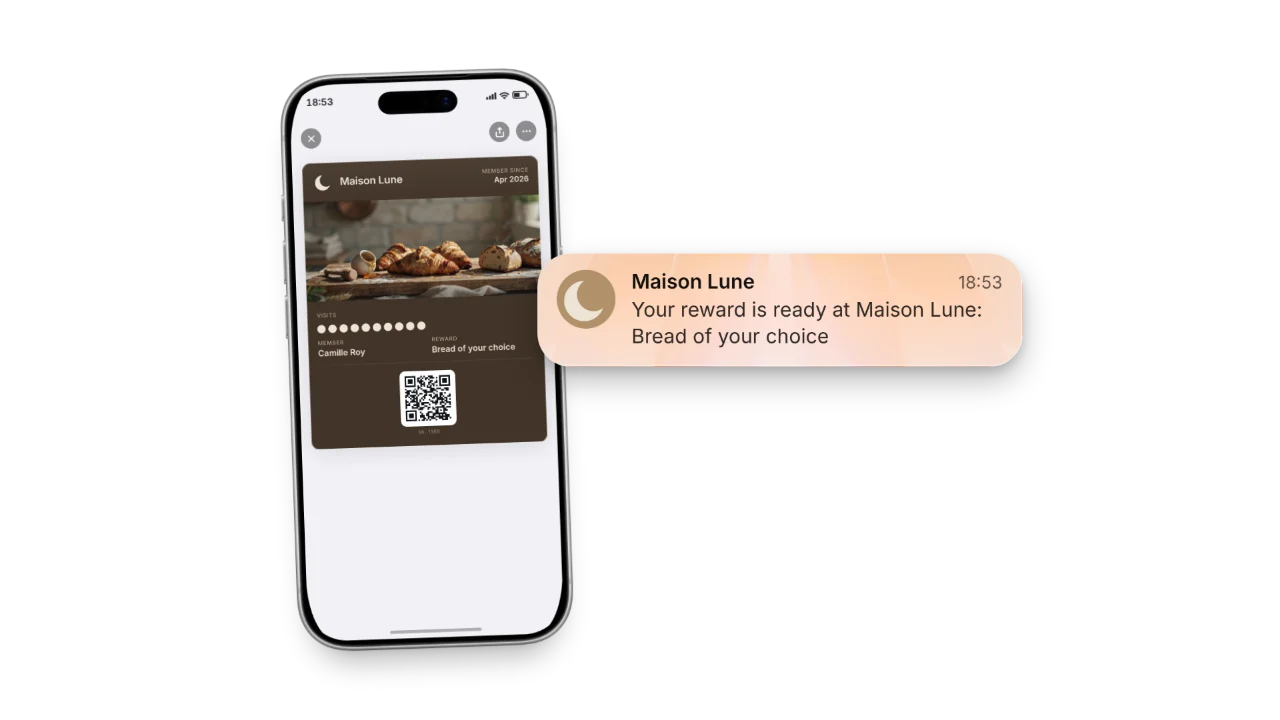
A loyalty pass lands in Apple Wallet, the visit is stamped and the reward notification arrives on the phone.
What should a bakery loyalty reward program count?
Reward the visit. In a bakery the frequent customer and the large customer are usually different people, and only one of them is a relationship. The neighbour buying bread most mornings spends more across a year than the person who ordered a tray for an office once, and a spend-weighted program quietly ranks them the wrong way round.
There is a second reason, and it is operational. Bakery baskets are small and quick, and anything that requires the counter to think about value slows a queue that is already the constraint on the whole morning. Counting visits is one press. That is the entire interaction, and it is the only version that survives contact with a rush.
How many stamps should a bakery loyalty card have?
Stamps, unless you sell celebration cakes alongside daily bread and the difference is genuinely large. In that case points earn against value honestly and the pass stops under-rewarding the customer who orders a birthday cake. Most bakeries are not that shop, and for most the stamp is right because it is instant.
The goal is a waiting time in disguise. Divide it by how often somebody actually shops with you and you have the weeks until the reward. A weekday-morning habit reaches a modest goal inside a couple of weeks, which is short enough that the pass stays interesting; the same goal for a Saturday-only customer is most of a season, and the goal should be shorter or aimed at the weekday trade.
Two things are worth saying about that number before you copy it. It is a design choice, and the only measured figure on this page is what other businesses picked. In Fideliya’s production data on 4 September 2026 there were fifteen live stamp cards, and their goals ran five on two cards, six on two, seven on one, ten on eight, twelve on one and fifteen on one, a median of ten. There were nine live points cards with a median goal of 750. The sample is small and concentrated, and that belongs in the same sentence: one restaurant is 84% of the wider holder sample those cards sit behind. Read it as what a handful of real businesses chose, never as a benchmark for yours. The same reasoning applied across fifteen trades is on fifteen punch card ideas.
A reward ladder that keeps them coming back
A bakery ladder should be cheap at the bottom, because the bottom is where it does its work.
- Give the first stamp at the counter when they join. A pass with one on it is a pass that has started.
- Put something small a few visits in. A pastry with a coffee, or the second of something, given without a discussion.
- Keep the named reward at the goal. Whatever the pass promises stays where it was promised.
- Price the reward across the whole cycle. A free loaf is a discount on every loaf before it, paid at the end.
- Decide what the second round offers before the first is claimed. Fideliya marks the reward available at the goal and resets on the claim, so the next lap starts immediately.
The one line that signs customers up while they wait
Offered while they are already waiting, not while they are paying:
“We’ve got a loyalty pass now, if you want it. Free, goes on your phone, scan the code while I bag this.”
The last clause is the one that keeps the queue moving. It gives the customer something to do during the part of the transaction they were spending anyway, so the pass costs the counter nothing. Say it at every sale, during the bagging rather than at the card machine: the card machine is the moment the queue is watching, and it is where a program starts feeling like an upsell.
The scan stays just as quick: point the phone at the code or type it, add the stamp in one tap, and Undo takes back a scan made by mistake in the seconds after it.
Set it up in seven days
Seven days, and none of them needs to happen before the morning bake.
| Day | What you do | Why it is that day |
|---|---|---|
| Day 1 | Decide the goal and the reward and write them down | It is the decision you cannot undo cleanly later |
| Day 2 | Design the pass and print a code for the display case | It has to be where people already stand waiting |
| Day 3 | Enrol staff and scan each other | A counter that has used it explains it in five words |
| Day 4 | Agree the one sentence | It is said during bagging, not during payment |
| Day 5 | Run it through a full morning rush | If it survives the rush it survives everything |
| Day 6 | Put the code on the bread bags or the receipt | It reaches the people who did not want to stop |
| Day 7 | Read the funnel and count second scans | A daily trade shows a second scan fast or not at all |
None of the seven days needs a full morning, and the seventh is the one that decides whether week two is worth planning. The step-by-step version, written for the counter rather than for the design, is on how to create a bakery loyalty program.
Know who’s due back before you lose them
Three numbers do the work, and they already have names on the dashboard. Returning counts the customers with two or more visits in the period, set against the period before, and it is the only honest test of whether the program changed anything. The funnel follows the same people from holding your pass to visiting, coming back, earning a reward and redeeming it, which is the difference between a pass people take and a pass people use. And Due back, on the Overview, counts everyone with no visit in over 30 days, names them, and puts Send them a message one tap away.
Due back opens the same people on your Customers page, under its Inactive filter, so the count and the list always agree. On Pro, Analytics also sorts your customers into New, Regulars, Due back and Lost, and Lost is anyone with no visit in 90 days or more. Check the funnel and Due back on the same day each month. A pass that fills in one busy morning and never gets scanned again told you something, and it told you early.
When Due back fills, you can reach exactly those people. A Fideliya broadcast is addressed: to everyone holding that pass, to the customers seen in the last 30 days, to those not seen for over 30, or to named individuals. Every message is yours: you pick who gets it and when it goes out, now or scheduled.
Bake for the customers who really come
Bakery waste is decided the night before, by what you choose to bake, and that stays your call. What the pass adds is the input a bake plan has always lacked: who your daily customers actually are.
Plan tomorrow’s bake around the people the pass shows you come in every morning. The retention view of the same numbers is on the bakery retention guide.
Sources
No Search Console query specific to bakeries appears in the three months to 1 September 2026, so this page mirrors none from that window and claims no demand it cannot show. The goal distribution is Fideliya production data measured on 4 September 2026 across external accounts, with its sample size and concentration caveat stated beside it. Every plan limit and product behaviour named above is cited to the file that implements it in the source note on this article. The suggested goal and the ladder are design choices for this page, not measurements, and this page quotes no third-party statistic.
What a bakery loyalty program costs
Fideliya is wallet-native loyalty program software for venues with a counter. Customers add a stamp or points pass to Apple Wallet or Google Wallet in one tap, with no app to download and no account to create. Fideliya runs stamps, points, gift cards and referrals on one platform in English, French, Spanish, Italian and Arabic with full right-to-left support. The free plan carries twenty customers at one location with the scanner included, and issues a real wallet pass. A bakery with a second shop needs Pro, at €49.99 a month, which carries 2,500 customers, four locations and five team seats, and the dashboard then records which counter each scan happened at. Set that against one regular who comes in every morning instead of going to the shop down the road. What the product does at the counter is described on the bakery loyalty program, and the plans are on the pricing page.
The first 14 days
- Day 1: print the QR code and put it by the till.
- At every payment, offer the pass: "Want the pass? One scan and it's done."
- Your team scans the pass at every visit.
- By day 14, you know who your regulars are.
Start your 14 days free. No card. If your regulars don't join, you pay nothing.