Your bakery keeps its regulars when you can see them leaving, and a wallet pass shows you exactly that. Ask a neighbourhood baker who their twenty best customers are and they will name five or six from memory. The rest they know by face, they know the order, they know who takes coffee with it, and they could not tell you how many times that person came this month or how long it has been since the last time. That gap is where a bakery's regulars leave from.
This guide treats retention as a system, not a campaign: what to design for, what to reward, what to measure, and what only looks like retention.
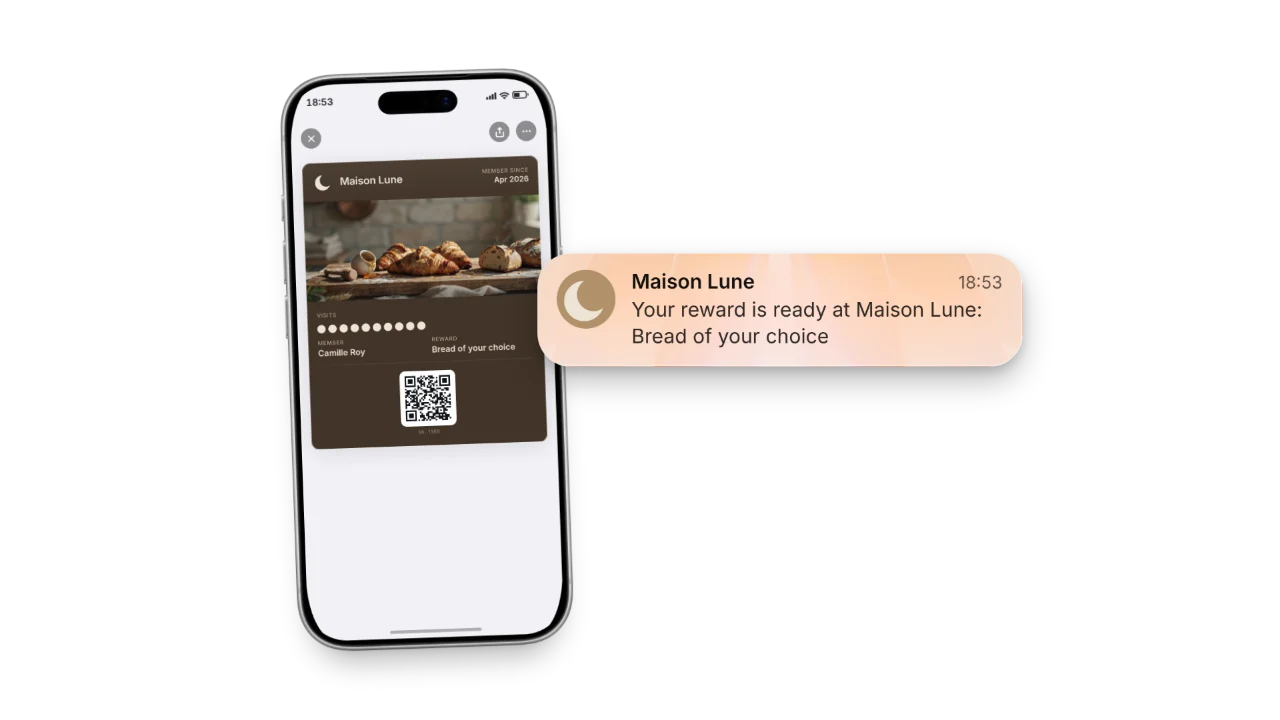
A loyalty pass lands in Apple Wallet, the visit is stamped and the reward notification arrives on the phone.
Why do bakeries lose regulars without noticing?
A bakery's losses are quiet. Nobody complains on the way out. A route to work changes, a family moves four streets over, a new bakery opens nearer home, a habit shifts. The customer does not decide to stop coming; they stop thinking about it. And because the stamps live on their card, the bakery finds out nothing at all.
How large that leak is in your shop is not a number anyone can hand you, and the figure that circulates in this category has no source we can name, so this page does not carry it. What can be measured is the shape once a pass is in place. In Fideliya's production data on 4 September 2026, of the 186 card holders ever scanned, 66 had not been back for 30 days or more, and 120 of the 255 enrolled cards had been active in the previous month. That sample is small and one restaurant account is 84 percent of it, so read it as one business's shape rather than as a bakery benchmark. The point is not the percentage. The point is that the list has names on it.
Win the second visit, and the tenth follows
Most bakery programs reward the tenth purchase, which rewards a behaviour that has already happened. The customer who comes ten times was coming ten times. The one you needed was the customer who came once and did not come back.
Ten is genuinely the common goal, and there is nothing wrong with it as the destination: on live Fideliya cards, 8 of the 15 stamp cards in the September 2026 sample use a goal of 10, with the rest spread between 5 and 15. What matters is what sits before it. Put something small at the second or third visit, inside the window where the decision is still open, and keep the goal at the end where it belongs. The full reasoning on goal length is on how many stamps a loyalty card should have.
Reward frequency, not spend
The customer who comes every morning for a single loaf is worth more than the one who comes once a month for a birthday cake. A spend-based scheme quietly penalises the daily buyer, which is precisely backwards for a bakery. One stamp per visit, whatever the basket, sends the signal you actually want: come back tomorrow, that is what counts.
And prefer the thing you make. A pastry you are proud of costs a fraction of its perceived value and introduces something the customer had not tried. A percentage off trains them to wait for the percentage.
Which three numbers show retention is working?
Three numbers say whether retention is working, and none of them is the count of passes issued.
| Number | What it means | How to read it |
|---|---|---|
| Return | Share of new holders who come back | Against your own first month, never against a category figure |
| Frequency, active holders | Average days between visits for the engaged group | Watch the direction. A widening gap means something changed |
| Gone quiet | Holders who used to come and have not been back | The only one of the three you can act on this week |
The third is what paper never produced. A short honest message to that list, a new sourdough on Wednesday rather than a discount, brings a share of them back, and you can write it today and schedule it for Wednesday morning, up to 30 days ahead. The rest were drifting anyway, and now you can tell which is which: each customer's page shows where they stand and their next step.
A card that shows customers how close the reward is
A wallet pass, the kind that lives in Apple Wallet and Google Wallet, is not a digital stamp card with extra steps. It is the feedback loop the cardboard never gave.
It also shows the customer where they are, which turns out to be what they ask for. Open Loyalty's Loyalty Program Trends page, updated on 24 April 2026 and built on 170 or more loyalty professionals, reports that 81 percent of consumers are interested in seeing progress displayed visually. On a wallet pass the count is on the card face, so nobody has to ask across the counter how many they have.
That matters for the other end too. Antavo's Global Customer Loyalty Report 2026, published on 3 February 2026 from 3,000 industry responses and a 10,000-member consumer panel, puts 27 percent of points earned during 2025 as never spent. A reward the customer earned and did not collect is worse than no reward: it is a promise the business made and the customer forgot. A pass that says the reward is ready, on the lock screen, closes most of that gap by itself.
Joining is a short form: a name and an email address, phone optional. No account, no password, no download. In the same September 2026 sample, 165 of the 186 holders ever scanned were scanned within an hour of adding the card, which is what enrolment at a counter looks like in the numbers, and the wallet split was near even at 131 Apple to 124 Google.
What brings regulars back, and what only looks like it
- The disguised discount. If the only reason someone returns is a percentage, that is not a regular, that is a price-sensitive buyer. Discounting is an acquisition channel; use it deliberately and call it by its name.
- Too many messages. Fideliya includes one broadcast a month on the free plan and three a month on Pro, and that rhythm is the right one. Send for a new bread, a Sunday opening, a reward about to land, and otherwise send nothing.
- Ignoring the product. No program saves bread people do not enjoy. The program multiplies work that already lands. If the second visit does not come and the reward is generous, the answer is in the oven or at the counter, not in the software.
What it costs to find out is nothing: the Fideliya free plan carries 20 customers at one location with the wallet pass and the browser-based scanner included and no credit card needed, enough to prove it at your counter. Pro at 49.99 euros a month carries 2,500 customers, four locations, five team seats and a CSV export of the list. The order to build in is on how to create a loyalty program for a bakery, and the case for dropping the paper card is on why bakeries replace stamp cards.
Sources
Antavo, Global Customer Loyalty Report 2026, published 3 February 2026, based on 3,000 industry survey responses and a 10,000-member consumer panel. Open Loyalty, Loyalty Program Trends, page updated 24 April 2026, based on 170 or more loyalty professionals. Both retrieved 4 September 2026. Own-data figures are Fideliya production aggregates measured on 4 September 2026 across external accounts: 255 enrolled cards, 186 ever scanned, 165 of those within an hour, 120 active in the previous 30 days, 66 quiet for 30 days or more, 131 Apple against 124 Google, and 8 of 15 stamp cards on a goal of 10; one restaurant account is 84 percent of that sample. Plan prices, caps and broadcast allowances are the published plans on the pricing page.
Fideliya is wallet-native loyalty program software for small businesses. Customers add a stamp or points card to Apple Wallet or Google Wallet in one tap, with no app to download and no account to create. Fideliya runs stamps, points, gift cards and referrals on one platform in English, French, Spanish, Italian and Arabic with full right-to-left support, and the free plan issues a real wallet pass for up to 20 customers. What the product does at a bakery counter is described on loyalty for bakeries, and the plans are on the pricing page.