Move your stamp card into Apple Wallet and Google Wallet and your bakery counts every visit, even at seven in the morning with a transaction every twenty seconds. The card is already in the phone that came out to pay, so one scan does what the paper card never had time for.
With paper, the owner is meant to find a card, stamp it and hand it back inside that rhythm. Most mornings that does not happen, and the loyalty programme quietly records a fraction of the visits it was bought to record.
This page is about what actually changes when a bakery moves that card into Apple Wallet and Google Wallet: what paper costs at speed, what the pass records instead, what our own cards show, and what the switch costs.
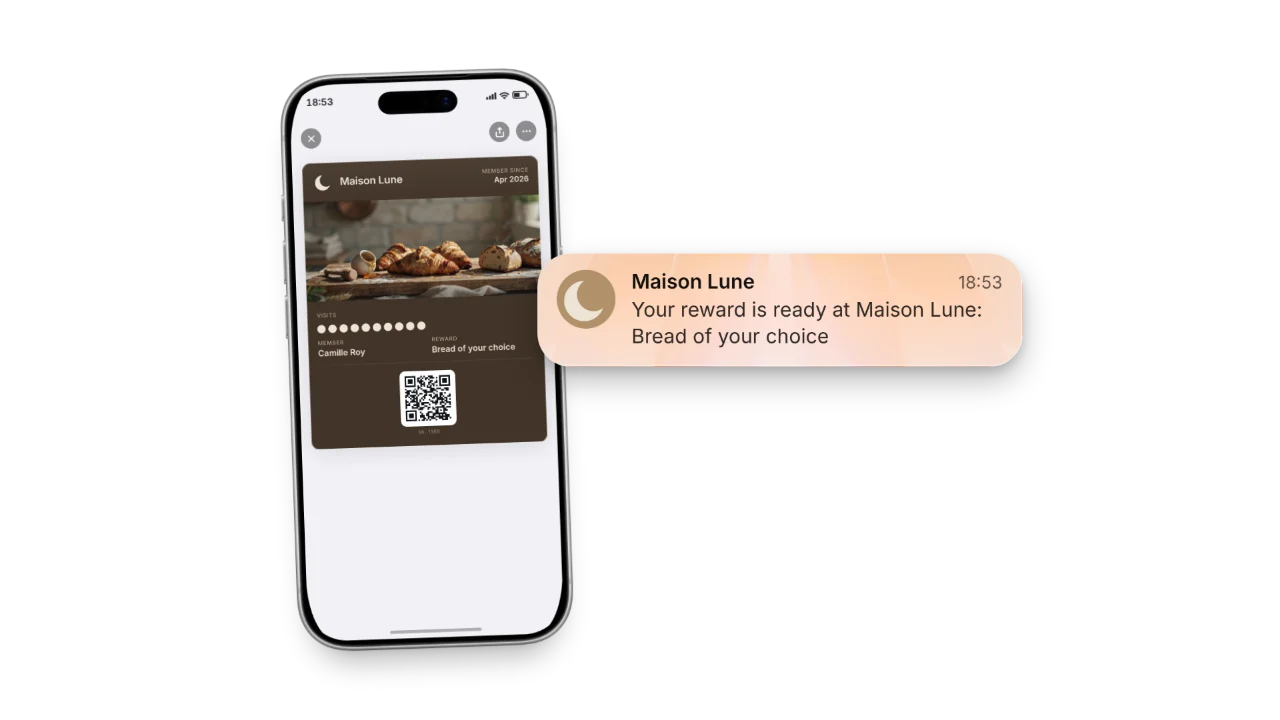
A loyalty pass lands in Apple Wallet, the visit is stamped and the reward notification arrives on the phone.
Why does paper miss visits at a busy counter?
A stamp card is a three-step transaction bolted onto a two-step one. The customer has to be carrying it, the customer has to remember it, and the person behind the counter has to have a free hand. At a slow counter all three are usually true. At a bakery counter in the morning, none of them reliably is, and the failure is silent: nobody complains about a stamp they did not think to ask for.
A wallet pass removes two of the three steps. The card is already in the phone that came out to pay, and the scan happens on the till side. What is left is one thing to point a camera at, which is the same gesture the payment already required. Staff scan the code or type it, add the stamp in one tap, and Undo reverses a mistaken scan in the seconds after it.
The evidence for where joining actually happens is in our own data. Of the 186 Fideliya card holders who have ever been scanned, 165 were scanned within an hour of adding the card, and 180 within twenty-four hours. Enrolment is a counter event, not a homework event. Any programme that assumes the customer will sign up later, at home, is designing for a moment that does not arrive.
See who stopped coming before they are gone
The paper card has one more problem, and it is the expensive one. The stamps live on the customer's card, which means the record lives with the customer. Ask a baker who their twenty best customers are and they will name five or six from memory. The rest they recognise by face, and could not tell you when they last came in.
So the thing a loyalty programme is for, noticing that a regular has stopped being a regular, is exactly the thing paper cannot do. By the time a familiar face has been absent long enough to be noticed, the habit has usually moved somewhere else.
| Question | Paper stamp card | Fideliya wallet pass |
|---|---|---|
| Where does it live? | A wallet, a coat, a drawer | Apple Wallet or Google Wallet |
| What records a visit? | A stamp, if the card is present | A scan of the pass at the counter |
| What if it is lost? | The visits are lost with it | The count is on the account, the pass is re-added |
| Who holds the record? | The customer | The customer and the bakery |
| Who has stopped coming? | Not answerable | Listed in the dashboard |
| Cost to start | Printing, per batch | 0 euros on the Fideliya free plan, 20 customers |
What Fideliya's own cards show
These figures are Fideliya production aggregates measured on 4 September 2026 across external accounts only. The sample is 255 enrolled cards and one restaurant accounts for 84 percent of it, so read them as the shape of a small sample rather than as an industry benchmark.
- 89 percent of first scans happen within an hour of joining (165 of the 186 holders ever scanned). The card is added at the counter and used immediately.
- Apple and Google split almost evenly: 131 Apple Wallet to 124 Google Wallet across 255 holders. A bakery cannot pick one platform and still serve the queue.
- Ten is the common stamp goal: 8 of the 15 live stamp cards use a goal of 10, and the rest sit between 5 and 15.
- 35 percent of scanned holders go quiet: 66 of 186 had not been back for 30 days or more. That list is the output paper never produced.
The fourth figure is the one worth acting on. A bakery cannot chase a customer it cannot name, and a paper card names nobody; on Fideliya, each customer's page shows where they stand and their next step. The reasoning behind the third is set out in full on how many stamps a loyalty card should have.
Nothing to carry for your customers
Nothing to carry, and nothing to remember. The pass sits beside the boarding card and the transit ticket, the counter is visible without asking, and the progress toward the next reward is a number rather than a guess. When a reward is ready, the card says so.
Joining is a short form: a name and an email address, with a phone number optional. There is no account to create and no password to set, and there is no app to install, which is the friction that stops most single-shop loyalty apps before they start. That trade is examined in detail on loyalty app or wallet pass.
What does switching cost a bakery?
The Fideliya free plan is 0 euros and carries 20 customers at one location, with a real Apple Wallet and Google Wallet pass, the browser-based QR scanner, and all five interface languages. No card details are required. For a bakery, 20 customers is a pilot: enough to prove the counter script works and that staff will actually say the sentence. Pro takes it from there.
Pro is 49.99 euros a month, or 39.99 euros a month billed yearly, and carries 2,500 customers, four locations, five team seats, gift cards, referrals and a CSV export of the customer list. New accounts also get 14 days of Pro features at signup with no card required. What competitors charge, each price verified at the vendor's own pricing page on 11 August 2026, is on what loyalty software costs in 2026.
Against that sits the cost of the paper: reprinting cards, the stamp, and the visits that were never counted. The second of those is the only one a bakery ever sees on an invoice, and it is the smallest.
What still matters most: the bread
The bread. A pass does not improve the crumb, and a customer who does not like the loaf is not retained by a counter on a screen. The programme is a multiplier on something that already works: it makes the regulars visible, and it brings back a share of the ones who drifted. A card that measures a bakery nobody wants to visit measures a bakery nobody visits.
The paper card is not broken. It is slower than the counter it sits on, and the counter is not going to slow down. Setting the programme up in order is covered step by step on how to create a loyalty program for a bakery.
Sources
Own-data figures on this page are Fideliya production aggregates measured on 4 September 2026 across external accounts: 255 enrolled cards, 186 ever scanned, of which one restaurant account is 84 percent of the sample. Plan prices and caps are the published plans on the pricing page. Competitor pricing referenced above was verified at each vendor's own pricing page on 11 August 2026. This page carries no third-party statistic.
Fideliya is wallet-native loyalty program software for small businesses. Customers add a stamp or points card to Apple Wallet or Google Wallet in one tap, with no app to download and no account to create. Fideliya runs stamps, points, gift cards and referrals on one platform in English, French, Spanish, Italian and Arabic with full right-to-left support, and the free plan issues a real wallet pass for up to 20 customers. What the product does for a bakery counter is described on loyalty for bakeries, and the plans are on the pricing page.