A spa loyalty card brings the client who said she would be back actually back, sooner, and turns a gift voucher into a first step. One scan at reception starts it, and her progress waits in her phone wallet.
The most common story in a treatment room is a voucher client who enjoyed it and was not seen for four months, and almost none of it is about the treatment. This page covers what to reward, which mechanic fits a price list that swings, and how packages fit in.
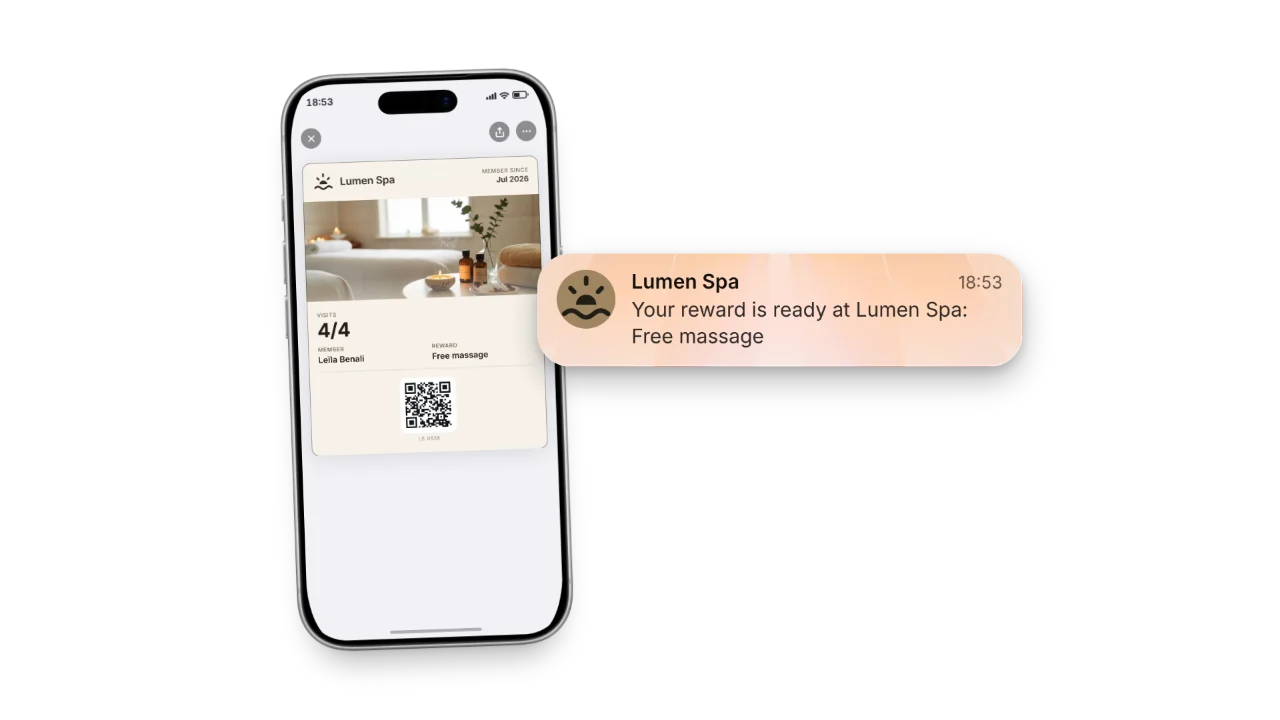
A loyalty pass lands in Apple Wallet, the visit is stamped and the reward notification arrives on the phone.
What should a spa loyalty program reward?
Reward the return. A spa is the clearest case on this list: visits are occasional, individually expensive, and almost entirely discretionary, which means the decision to come back is made slowly and can be lost simply by not being made. Anything that shortens that interval is worth more than anything that increases the basket on the day.
It also means the card should count the visit rather than the treatment. A client who books a short add-on because that is what the week allowed has still returned, and a program that rewards only the long treatment tells her the small visit did not count. It did. It is the visit that keeps the relationship alive between the ones that pay for it.
Stamps or points for a spa, and how many?
Both are defensible here and the choice follows the price list. If the spread between a short add-on and a signature treatment is wide, points earn against value and nobody feels short-changed. If you would rather reward the act of returning regardless of what was booked, stamps say that plainly, and a stamp card is easier to explain at reception when somebody is putting their coat on.
The goal is a waiting time in disguise, and spas set it too long more often than any other trade on this list. Divide it by how often a client realistically books and read the answer in months rather than weeks. A short card with a reward worth having beats a long card with a better one, because the long card is a promise about a relationship neither of you has agreed to yet.
Two things are worth saying about that number before you copy it. It is a design choice, and the only measured figure on this page is what other businesses picked. In Fideliya’s production data on 4 September 2026 there were fifteen live stamp cards, and their goals ran five on two cards, six on two, seven on one, ten on eight, twelve on one and fifteen on one, a median of ten. There were nine live points cards with a median goal of 750. The sample is small and concentrated, and that belongs in the same sentence: one restaurant is 84% of the wider holder sample those cards sit behind. Read it as what a handful of real businesses chose, never as a benchmark for yours. The same reasoning applied across fifteen trades is on fifteen punch card ideas.
A reward ladder that keeps them coming back
Short card, few rungs, and the first one placed against the interval rather than the spend.
- Give the first stamp at reception when they join. The card should never start empty in a trade where the second visit is the hard one.
- Put an add-on second. A scalp massage or an extension of the treatment they already book, which costs time rather than margin.
- Keep the signature reward at the goal. It is what the card is for and it should stay at the end.
- Use the gift card for anything sold up front. Fideliya opens gift cards on Pro with one template and on Enterprise with unlimited templates, and the holder joins your loyalty pass with one scan of the spa's QR code, like any client.
- Price the ladder against a client who never rebooks. That is the alternative it is competing with, not the menu price.
In plan terms the card, the pass and the scanner are on the free plan, which carries twenty clients at one location. Pro is the plan a spa reaches for gift cards and five team seats, which is the point at which a therapist can enrol somebody without reception.
The line to say at reception on the way out
Said at reception, on the way out, while the next appointment is being discussed:
“Let me put you on our card before you go. It’s free, it’s on your phone, and today already counts.”
Today already counts is the clause that matters, because a spa client’s next visit is not scheduled by habit and the card has to give her something now rather than a promise about later. Say it while she is standing at the desk rather than in the treatment room; the room is for the treatment, and a program mentioned there reads as a sales conversation in a place that should not have one.
The scan itself stays quick: point the phone at the code or type it, add the stamp or the points in one tap, and Undo takes back a scan made by mistake in the seconds after it.
Launch it in seven days
Seven days, and reception can do all of them.
| Day | What you do | Why it is that day |
|---|---|---|
| Day 1 | Decide stamps or points against your treatment list | A wide price spread is the case for points |
| Day 2 | Design the card and print a code for reception | The desk is where the coat goes on and the phone comes out |
| Day 3 | Enrol the team and scan each other | Reception explains what reception has used |
| Day 4 | Agree the one sentence at the desk | Never in the treatment room |
| Day 5 | Offer it to every client for a full day | Including the ones on vouchers, especially those |
| Day 6 | Attach it to gift voucher redemptions | It is the cheapest new-client source a spa has |
| Day 7 | Read the funnel and count who came back | A spa’s second visit is weeks away; day 7 shows the first |
None of the seven days needs a full morning, and the seventh is the one that decides whether week two is worth planning. The step-by-step version, written for the counter rather than for the design, is on how to create a spa loyalty program.
Know who’s due back before you lose them
Three numbers do the work, and they already have names on the dashboard. Returning counts the clients with two or more visits in the period, set against the period before, and it is the only honest test of whether the program changed anything. The funnel follows the same people from holding your card to visiting, coming back, earning a reward and redeeming it, which is the difference between a card people take and a card people use. And Due back, on the Overview, counts everyone with no visit in over 30 days, names them, and puts Send them a message one tap away.
Due back opens the same people on your Customers page, under its Inactive filter, so the count and the list always agree. On Pro, Analytics also sorts your customers into New, Regulars, Due back and Lost, and Lost is anyone with no visit in 90 days or more. Check the funnel and Due back on the same day each month. A card that fills through a voucher season and never gets scanned again is a card that told you something, and it told you early.
When Due back fills, you can reach exactly those people. A Fideliya broadcast is addressed: to everyone holding that card, to the customers seen in the last 30 days, to those not seen for over 30, or to named individuals. Every message is yours: you pick who gets it and when it goes out, now or scheduled.
Sell packages up front, then bring clients back
Fideliya is spa loyalty software. A prepaid balance goes on the gift card, the return goes on the loyalty card, and neither one bills anybody every month.
Where the model is a course of treatments bought together, the card’s role is what happens afterwards: the client who finishes a package and has no reason to book again is precisely the person a short ladder is for. Winning that client back is the subject of win back spa clients.
Sources
Search Console recorded "spa loyalty software" at 527 impressions and average position 24.4, and "spa loyalty program" at 160 impressions and position 42.6, in the three months to 1 September 2026; both figures live in the source note rather than in the prose. The goal distribution is Fideliya production data measured on 4 September 2026 across external accounts, with its sample size and concentration caveat stated beside it. Every plan limit and product behaviour named above is cited to the file that implements it in the source note on this article. The suggested goal and the ladder are design choices for this page, not measurements, and this page quotes no third-party statistic.
Fideliya is wallet-native loyalty program software for small businesses. Customers add a stamp or points card to Apple Wallet or Google Wallet in one tap, with no app to download and no account to create. Fideliya runs stamps, points, gift cards and referrals on one platform in English, French, Spanish, Italian and Arabic with full right-to-left support, and the free plan issues a real wallet pass for up to 20 customers. What the product does at the counter is described on the spa loyalty program, and the plans are on the pricing page.