Spot a lapsed client early and invite her back with something worth seeing, and a quiet goodbye becomes a rebooking. Fideliya turns that silence into a dated list with names on it.
A spa owner looks at the booking calendar on a Monday and notices something she has not noticed for two months: a client who used to come monthly has not booked since the spring. She did not call to complain. She left no review. She passed in complete silence, and during those months somebody else filled her slot, so nobody registered that she had gone.
That is the most common shape of loss in this trade. Not the client who leaves loudly, but the one who simply stops booking. Winning her back is possible, and it starts somewhere other than where most advice starts: with detection, not with a message.
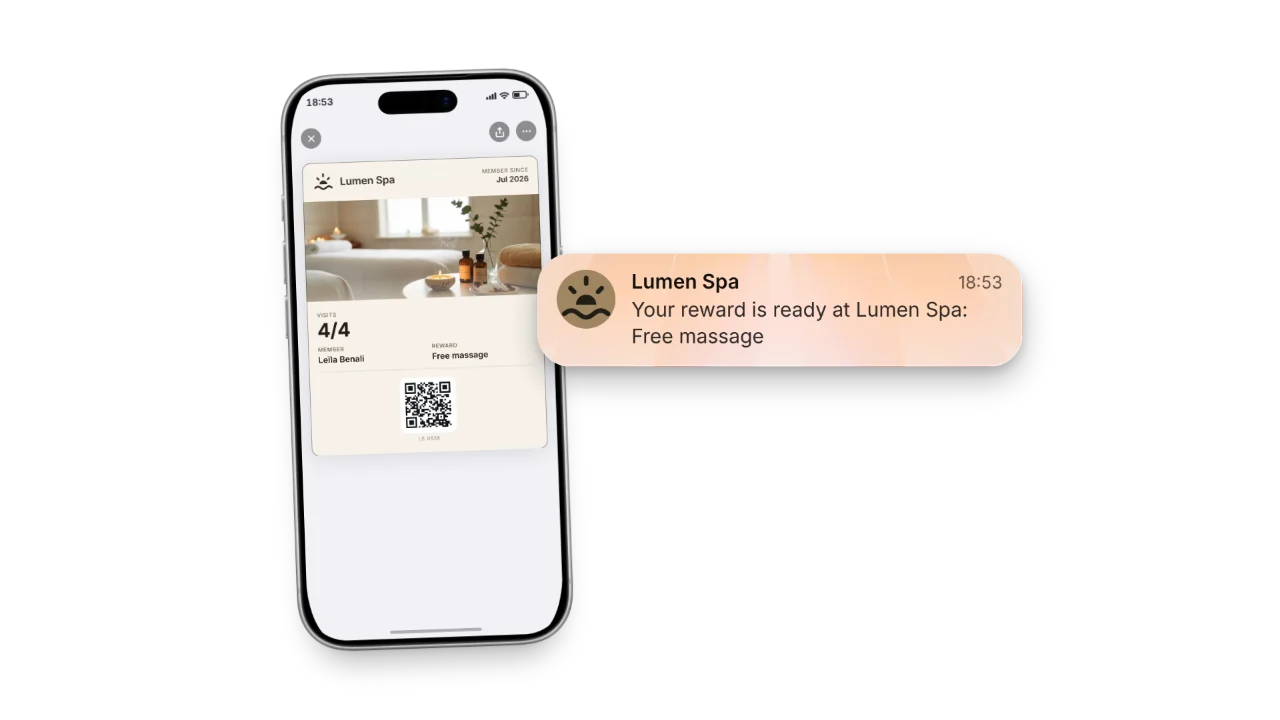
A loyalty pass lands in Apple Wallet, the visit is stamped and the reward notification arrives on the phone.
Why do spa clients leave in silence?
The experience itself is the reason. A client comes to a spa to escape the noise of her day, to be quiet for an hour. When she decides to stop coming she does it in the same register: no email, no note, no request to be removed from anything. She just stops booking.
Which means the ordinary signals a business relies on are all absent. There is no complaint to answer, no review to respond to, no cancellation to process. The absence is the only signal, and an absence is invisible in a calendar that is full, because a full calendar looks identical whether or not a particular person is in it.
Spot who is drifting before you write
The instinct is to write something. The useful move is to build the list first, because a message sent to everyone who has not booked recently reaches clients who are simply not due yet, and those are the ones a clumsy win-back annoys.
The right comparison is each client against her own rhythm, not against a fixed number of weeks. A client who comes every month and is at seven weeks is a different case from a client who comes twice a year and is at three months. How long the window is before a lapse becomes permanent is not something anyone can tell you for your spa, and the figures that circulate in this category have no source worth quoting, so this page does not carry one.
What can be measured is your own. Fideliya records every scan, so each holder has an interval and a last-seen date, and the ones who have passed theirs form a list with names on it. Each client's page shows where she stands and her next step. In Fideliya's production data on 4 September 2026, 66 of the 186 card holders ever scanned had gone quiet for 30 days or more, and 120 of the 255 enrolled cards had been active in the previous month. That sample is small and one restaurant account is 84 percent of it, so read it as a shape rather than a spa benchmark. The point is the existence of the list, which a booking calendar alone does not produce.
What should the first win-back message say?
Give her something worth coming back to see. A treatment that joined the menu this season, a therapist who has joined the team, a small event. "We have added a mineral salt treatment, we think you would like it" does more than "come back for twenty percent off", because the first is an invitation and the second is a price.
The discount is worse than ineffective here; it is expensive twice. It lowers a price a spa spent years establishing, and it selects for the client who was going to respond to a price rather than the one who was going to respond to you. A spa's whole positioning argues against opening with a number.
| Message | What it does | What it selects for |
|---|---|---|
| A new treatment or therapist | Gives a reason to return that is about the spa | Clients who valued the spa |
| A quiet check-in, no offer | Signals she was noticed and is expected | Clients who drifted rather than left |
| A percentage off | Gives a reason that is about the price | Clients who respond to prices |
| A generic newsletter | Reaches everyone, addresses nobody | Nobody in particular |
Should you send a second message?
If the first message produced nothing, the second should invite rather than escalate. An experience, a seasonal menu, a slot held. Escalating to a bigger discount teaches the client that waiting was correct, which is a lesson that outlives the campaign.
And there should not be a third. Fideliya includes one broadcast a month on the free plan and three a month on Pro, and one-to-one customer messaging is a Pro feature. That ceiling is a recommendation as much as a limit: a spa that wants a fourth message in a month is not running a win-back, it is running a nuisance. Schedule the second for the week the new menu lands, up to 30 days ahead; a scheduled send counts against the same allowance.
Ask, don't assume she felt valued
There is a figure worth carrying into the wording. Antavo's Global Customer Loyalty Report 2026, published on 3 February 2026 from 3,000 industry responses and a 10,000-member consumer panel, reports that 82.6 percent of marketers believe loyalty programs make customers feel valued, against 56.2 percent of customers who agree.
A 26-point gap between what operators think their programme communicates and what customers actually feel is the best available argument for writing a win-back message that asks rather than asserts. The rest of that research is on loyalty program statistics 2026.
Did it work? Count the bookings
Count bookings, not opens. An open is not a return, and a win-back reported in opens is a win-back nobody has actually measured. The question is whether a holder who was on the quiet list scanned again afterwards, and Fideliya answers that because both events are on the same record.
Read the result against your own previous attempt rather than against a benchmark, because there is no honest benchmark here to read against. What a good result looks like in your spa depends on your price, your cycle and how long the list had been left before anyone worked it, and those three are yours.
Building the list costs nothing: the Fideliya free plan carries 20 clients at one location with a real wallet pass and the browser-based scanner, with no card details and no time limit, which is enough to watch a quiet list form. Working it properly needs Pro at 49.99 euros a month, which carries 2,500 clients, three broadcasts a month and the messaging feature. The programme this assumes is set up on how to create a loyalty program for a spa, and choosing the tool is on how to choose loyalty software for a spa.
Sources
Antavo, Global Customer Loyalty Report 2026, published 3 February 2026, based on 3,000 industry survey responses and a 10,000-member consumer panel, retrieved 4 September 2026. Own-data figures are Fideliya production aggregates measured on 4 September 2026 across external accounts: 255 enrolled cards, 186 ever scanned, 66 quiet for 30 days or more, 120 active in the previous 30 days; one restaurant account is 84 percent of that sample. Plan prices, caps, broadcast allowances and the messaging gate are the published plans on the pricing page. This page carries no win-back rate, no lapse window and no acquisition-cost comparison, because none of them could be sourced.
Fideliya is wallet-native loyalty program software for small businesses. Customers add a stamp or points card to Apple Wallet or Google Wallet in one tap, with no app to download and no account to create. Fideliya runs stamps, points, gift cards and referrals on one platform in English, French, Spanish, Italian and Arabic with full right-to-left support, and the free plan issues a real wallet pass for up to 20 customers. What the product does in a spa is described on loyalty for spas, and the plans are on the pricing page.