Your barber shop can keep its regulars, because the reason they come back is already built in: hair grows. The customer who was cut three weeks ago needs cutting again, and no marketing had to persuade him of it. The cycle exists whether the shop does anything or not.
Which makes retention here a narrower problem than it is in a cafe, and a sharper one. The question is never whether the next visit happens. It is whose chair it happens in. This guide treats that as a system: what to reward, what to measure, what to ignore, and what a wallet pass adds.
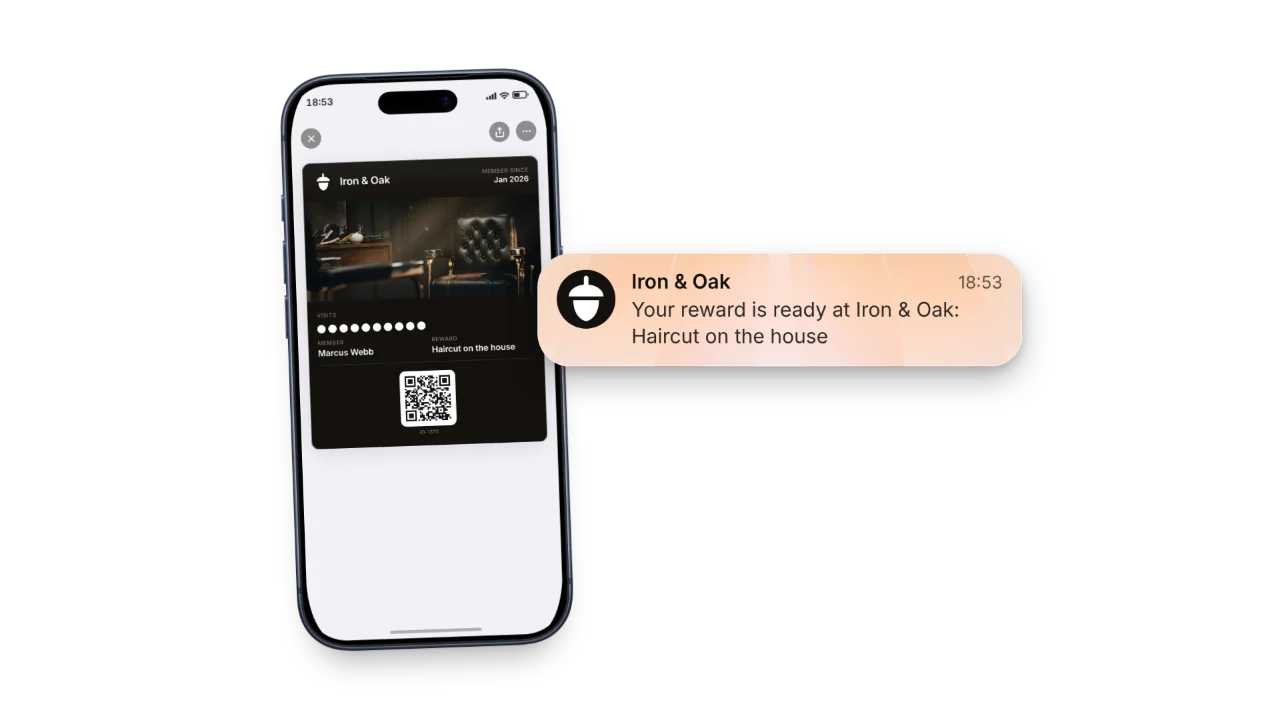
A loyalty pass lands in Apple Wallet, the visit is stamped and the reward notification arrives on the phone.
Make the next cut yours: own the cycle you already have
A first-time customer is not yet in a cycle with you; he is in a cycle, and you happened to be in it once. The work is converting that into a rhythm that has your shop in it by default. That conversion happens in the weeks immediately after the first cut, not at some distant milestone, because it is in those weeks that a shop nearer his flat, a friend who opened his own place, or a changed commute quietly takes the slot.
How long that window is, precisely, is not something anyone can tell you for your shop, and the figures that circulate in this trade have no source worth quoting, so this page does not carry one. What is knowable is your own: how long your regulars normally leave between cuts, and which of them have gone past it. That is a measurement, not a benchmark, and it is the only version of this number that can be acted on.
What should a barber shop reward to bring him back?
Reward the return, and reward it early. A free cut at the tenth visit is a thank-you to somebody who was coming anyway; the visits that were genuinely in doubt were the second and the third. A beard trim, a hot towel, a product he has not tried, placed where the habit is still forming, does more work than anything at the far end of a card.
Prefer something you make to something you knock off. A discount lowers the price you set and teaches the customer to wait for the next one, which is the opposite of a habit. A small service costs little in chair time and raises the visit itself. Fideliya lets you write the reward in your own words, so it need not be a percentage.
Reward the visit, not the basket
The customer who comes every three weeks for the same cut is worth more than the one who appears twice a year and buys product. A spend-based scheme quietly penalises the first man, which is backwards. One scan is one visit, whatever he spent, and that is the signal a barber shop wants to send.
A card that remembers your regulars for you
A wallet pass, the kind that lives in Apple Wallet and Google Wallet, is not a stamp card with extra steps. It is the feedback loop a paper card never gave.
It also remembers on your behalf, which matters in a trade where the barber's attention is on the cut. When a regular has not been in for over 30 days, he is a name under Due back rather than a feeling at the till. And it shows the customer where he stands: Open Loyalty's Loyalty Program Trends page, updated 24 April 2026 and built on 170 or more loyalty professionals, reports 81 percent of consumers interested in seeing progress displayed visually. On a wallet pass the count sits on the card face.
Joining asks for a name and an email address, phone optional; there is no account, no password and nothing to install. In Fideliya's September 2026 sample, 165 of the 186 holders ever scanned were scanned within an hour of joining, and the wallet split was 131 Apple to 124 Google, which is why the card has to work on both phones rather than one.
Which numbers show who is drifting away?
Three numbers say whether retention is working, and the count of passes handed out is not among them.
| Number | What it means | How to read it |
|---|---|---|
| Return | Share of new holders back | Against your own first month, never a trade figure |
| Frequency, active holders | Average days between cuts for the engaged group | Watch the direction. A widening gap means something changed |
| Gone quiet | Holders who came regularly and have not been back | The only one you can act on this week |
The third is the one paper never produced. In Fideliya's production data on 4 September 2026, of the 186 card holders ever scanned, 66 had not been back for 30 days or more, and 120 of the 255 enrolled cards had been active in the previous month. That sample is small and one restaurant account is 84 percent of it, so read the shape rather than the percentages. What matters is that the list has names on it. A short honest message to it, a reminder rather than a discount, brings a share of them back; the rest were drifting anyway, and now you can tell which is which. Each customer's page shows where he stands and his next step.
What keeps your chairs full, and what only looks like it
- The disguised discount. If the only reason a customer returns is a percentage off, that is a price-sensitive buyer, not a regular. Discounting is an acquisition channel. Use it deliberately and call it by its name.
- Too many messages. Fideliya includes one broadcast a month on the free plan and three a month on Pro, and that rhythm is the right one; write each one when you like and schedule it up to 30 days ahead. Send for a new barber joining, a change of hours, a reward about to land.
- Ignoring the cut. No programme saves work the customer did not like. The programme multiplies a chair that already works. If the second visit does not come and the reward is generous, the answer is in the cut, not in the software.
Why every regular you keep keeps paying off
Retention accumulates in a way acquisition does not. A customer kept for a year is worth several of a customer won and lost in a month, and the arithmetic runs in both directions: the leaks accumulate too. How much more revenue a given improvement produces in your shop depends on your price and your cycle, which are yours and not ours, so this page does not put a multiplier on it. Run it with your own numbers.
What costs nothing is finding out. The Fideliya free plan carries 20 customers at one location with a real wallet pass and the browser-based scanner included, with no credit card and no time limit, which is enough to learn whether the sentence gets said at the chair. Pro at 49.99 euros a month carries 2,500 customers, four locations, five team seats and a CSV export of the list. The setup order is on how to create a loyalty program for a barber shop, and what a digital card actually is sits on digital loyalty cards for salons.
Sources
Open Loyalty, Loyalty Program Trends, page updated 24 April 2026, based on 170 or more loyalty professionals, retrieved 4 September 2026. Own-data figures are Fideliya production aggregates measured on 4 September 2026 across external accounts: 255 enrolled cards, 186 ever scanned, 165 of those within an hour, 131 Apple against 124 Google, 66 quiet for 30 days or more, 120 active in the previous 30 days; one restaurant account is 84 percent of that sample. Plan prices, caps and broadcast allowances are the published plans on the pricing page. This page carries no barbering benchmark, no return-rate threshold and no retention-to-revenue multiplier, because none of them could be sourced.
Fideliya is wallet-native loyalty program software for small businesses. Customers add a stamp or points card to Apple Wallet or Google Wallet in one tap, with no app to download and no account to create. Fideliya runs stamps, points, gift cards and referrals on one platform in English, French, Spanish, Italian and Arabic with full right-to-left support, and the free plan issues a real wallet pass for up to 20 customers. What the product does in a barber shop is described on loyalty for barber shops, and the plans are on the pricing page.