A loyalty program pays for itself in any shop where customers come back, and five checks tell you whether yours is one. The automatic answer owners hear from consultants and advertising is yes, you need one; the useful question is "what has to be true about my shop for one to pay for itself?"
Pass three and a program will repay the effort comfortably. Pass none and something else comes first.
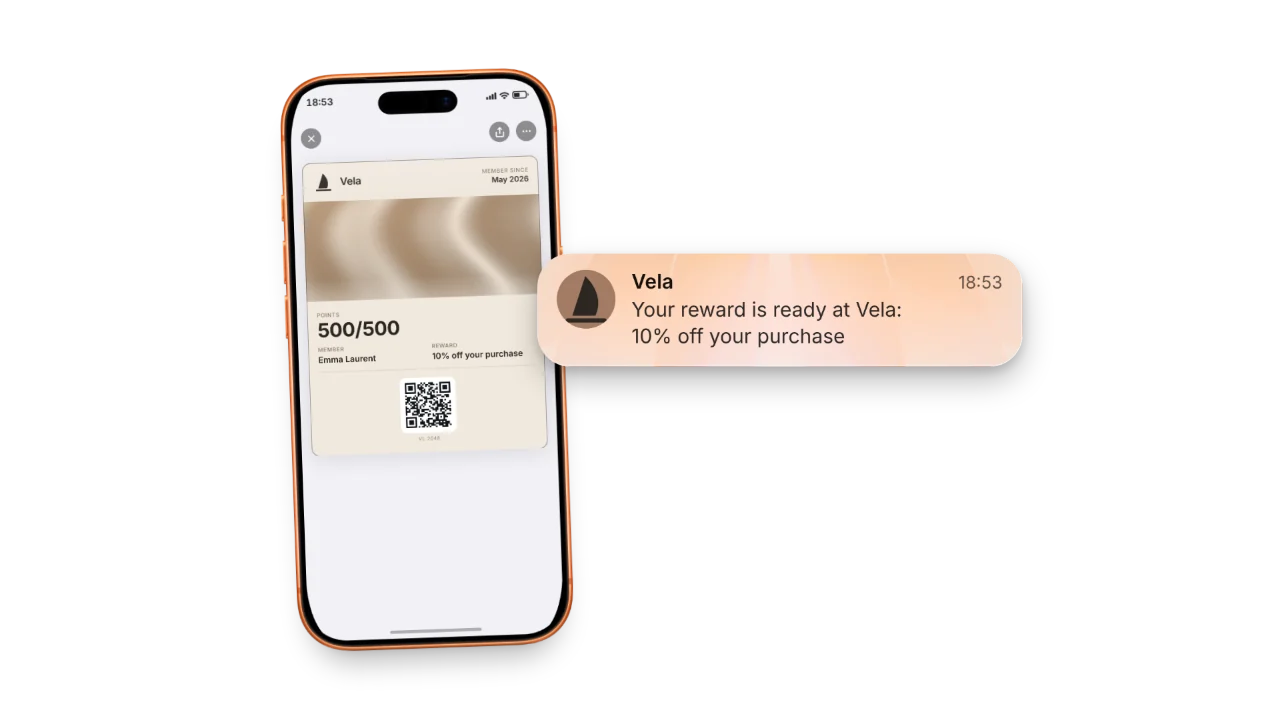
A loyalty pass lands in Apple Wallet, the visit is stamped and the reward notification arrives on the phone.
Check one: do customers come back at all?
The foundational question, because a loyalty program rewards repeat behaviour and nothing else. If your goods are bought once in a lifetime, or once a decade, a program is not solving a problem you have. Furniture, major appliances, a full home fit-out after a wedding: the customer is not returning until the next renovation, and no program changes that.
But if your customer returns, even once every couple of months, there is a behavioural cycle to reinforce. Clothing, accessories, fragrance, health products, gifts, books: all see repeat visits. Those are the shops where a program has something to work with.
Check two: can you name your best twenty customers?
A harsh and revealing test. Name, out loud, the twenty most valuable customers in your shop. How many can you actually name? For how many do you know the visit rhythm, the last time they came, what they lean towards buying?
Most owners manage five or six by face and lose the rest in the noise of the working day. That gap between what the shopkeeper sees and what the shopkeeper knows is precisely what a program fills. It is worth noticing that the gap is invisible from the inside: nobody feels like they are forgetting customers.
Check three: do customers arrive as a name or as a number?
A shop selling to a number, everyone who walks in, looks, buys, leaves, is running a footfall economy. A program is secondary there; the priority is raising footfall itself through location, window, hours and range.
A shop selling to a name, where the assistant knows that a particular customer comes on Wednesday evenings, prefers blue, and is buying for a young child, is running a relationship economy. A program there is not an addition, it is the natural infrastructure of the model. Everything a good salesperson does by instinct for six people, the program does systematically for all of them.
Check four: do you know why customers stop coming?
This check separates shops that can see their leak from shops working blind. If the honest answer to "why did the customers who used to come stop?" is "I do not really know", then some share of your base is leaving every year and you hold no information you could act on.
How large that share is in your shop is not a number anyone can hand you, and the figure that circulates in this category has no source worth quoting, so this page does not carry one. In Fideliya's production data on 4 September 2026, 66 of the 186 cards ever scanned had gone quiet for 30 days or more, and 120 of the 255 enrolled cards had been active in the previous month. That sample is small and one restaurant account is 84 percent of it, so the shape matters rather than the percentages. The point is that before a program exists the number is not merely unknown, it is unknowable.
Check five: what can I reward customers with?
A program needs a reward worth returning for. If margins are thin enough that a small gift is a real cost, a program can become a drain rather than an investment, which is the honest situation for shops selling near-commodity goods in small volumes.
Fortunately rewards need not be money or discounts. Early access to a new range before the public, a personal consultation with the head of the shop, a first look at a product before launch, a small credit after a number of visits: all low cost, high perceived value. But if nothing in your stock or your service can be made exclusive, the program has no heart.
| Checks passed | What that means | What to do |
|---|---|---|
| Four or five | The model is built on repeat relationships | Start. The free plan tests it at no cost |
| Three | Worth doing, with a reward you can actually afford | Start small and watch check four |
| One or two | Something upstream matters more | Location, window, range, staffing or pricing first |
| None | A program would be a cost with nothing to attach to | Revisit the question in a year |
Do loyalty programs really pay? What the industry reports
Antavo's Global Customer Loyalty Report 2026, published on 3 February 2026 from 3,000 industry responses and a 10,000-member consumer panel, reports that 92.7 percent of program owners say their program returns more than it costs, at an average of 5.3 times. Read that for what it is: operators reporting on their own programs, not an independent audit, and the people who abandoned a program are less likely to be answering a loyalty survey.
The same report carries a figure that cuts the other way and is more useful for this decision: 82.6 percent of marketers believe loyalty programs make customers feel valued, against 56.2 percent of customers who agree. A 26-point gap between what operators think their program does and what customers feel is the best argument in this article for testing rather than assuming. The rest of that research is on loyalty program statistics 2026.
What if my shop isn't ready yet?
If your shop passes fewer than three of the five, a program is probably premature. The priority is something else: the location, the window, the sales floor, the product mix, the pricing. Those raise footfall itself, and without enough footfall a program has nothing to build on.
Waiting is not a loss, it is a choice about timing. And the cost of being wrong in either direction is low here, because finding out is free: the Fideliya free plan carries 20 customers at one location with a real wallet pass and the browser-based scanner, with no credit card and no time limit. Twenty customers is enough to learn whether they come back, which is the only evidence that settles this question for your shop rather than for shops in general. When the answer turns out to be yes, the setup order is on how to create a loyalty program for a boutique and the prices are on what a loyalty program costs for a boutique.
Sources
Antavo, Global Customer Loyalty Report 2026, published 3 February 2026, based on 3,000 industry survey responses and a 10,000-member consumer panel, retrieved 4 September 2026. Own-data figures are Fideliya production aggregates measured on 4 September 2026 across external accounts: 255 enrolled cards, 186 ever scanned, 66 quiet for 30 days or more, 120 active in the previous 30 days; one restaurant account is 84 percent of that sample. Plan prices and caps are the published plans on the pricing page. This page carries no retail churn benchmark, because none could be sourced.
Fideliya is wallet-native loyalty program software for small businesses. Customers add a stamp or points card to Apple Wallet or Google Wallet in one tap, with no app to download and no account to create. Fideliya runs stamps, points, gift cards and referrals on one platform in English, French, Spanish, Italian and Arabic with full right-to-left support, and the free plan issues a real wallet pass for up to 20 customers. What the product does in a shop is described on loyalty for boutiques, and the plans are on the pricing page.