Your loyalty program can cost nothing until it has proved it brings customers back, and then it grows with your customer list. That is the answer a boutique owner wants when the fixed costs come up each quarter. The trap is not paying too much. It is paying for capacity a single shop will never use, or staying free after the program has already proved it brings customers back.
This page carries the prices that exist rather than a band. Every competitor figure was verified at that vendor's own pricing page on 2 October 2026, and every Fideliya figure is a published plan. Where the arithmetic needs a number only you have, it says so instead of guessing.
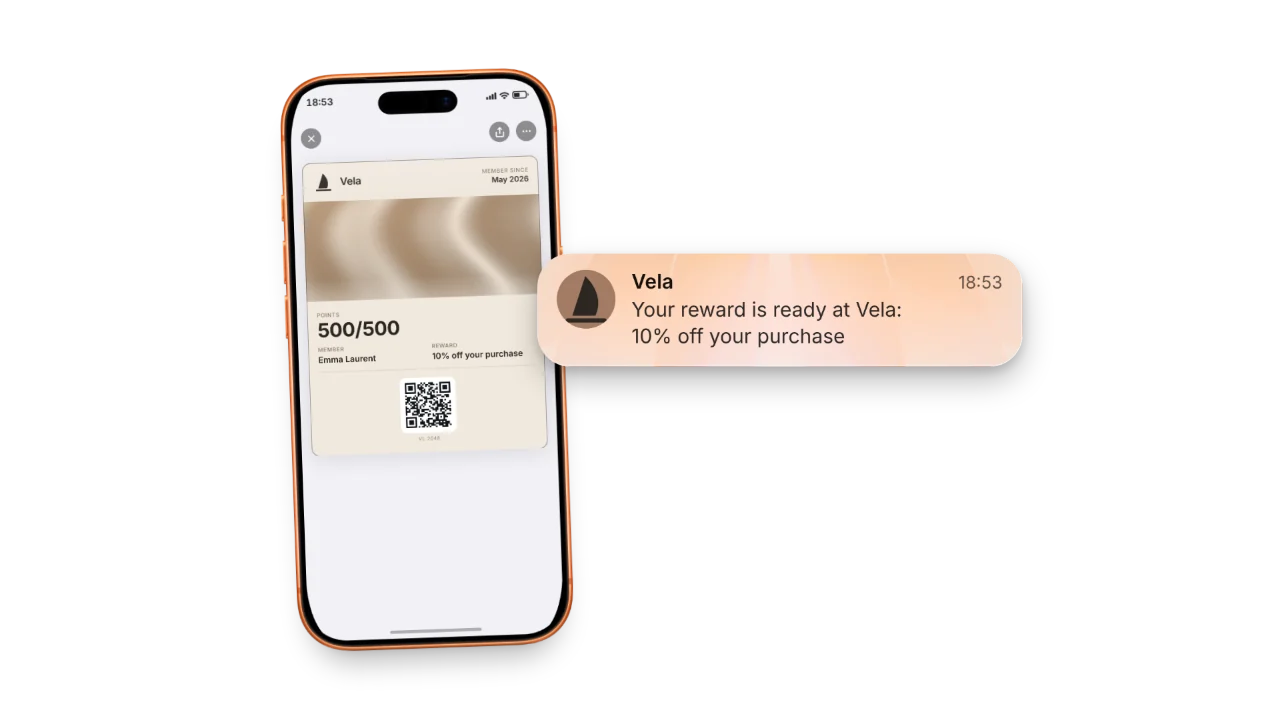
A loyalty pass lands in Apple Wallet, the visit is stamped and the reward notification arrives on the phone.
How much does boutique loyalty software cost?
Five platforms, seven rows. Prices are as published by each vendor in its own currency, not converted, because a conversion would put a number on this page that no vendor states.
| Plan | Entry price | Free plan | Beyond stamps |
|---|---|---|---|
| Fideliya Free | 0 euros | 20 customers, live wallet pass | Stamps or points |
| Fideliya Pro | 49.99 euros a month | Upgrade from Free | Stamps, points, gift cards, referrals |
| Fideliya Enterprise | from 99.99 euros a month | Upgrade from Free | Everything in Pro, plus webhooks |
| BonusQR Basic | 19 euros a month | Yes, unlimited customers | Seven schemes; points from 19 euros |
| FaveCard Pro | 39 USD a month | Yes, unlimited customers | Stamps only |
| Loopy Loyalty Starter | 25 USD a month | No, 15-day trial | Stamps only |
| LoyaltyPass | from 9,500 USD, one-time build | No, demo first | Points, stamps, tiers and memberships |
Three of the vendors above publish their price in US dollars and one in euros, and each is quoted here in the currency its own pricing page uses, with no conversion. A converted price is a number nobody published, and it goes stale twice: once when the vendor changes it and once when the rate moves. Every figure in the table was read at the vendor's own pricing page on 2 October 2026, and competitor pricing in this category changes often enough that the date matters as much as the number.
The vendor-by-vendor version of this table, with the same date, is on what loyalty software costs in 2026.
Pay only for what your boutique uses
Retail is not high-frequency. A boutique sees a regular a few times a season rather than a few times a week, which changes which line of the price table matters. The customer cap fills slowly and the location count usually stays at one, so the cap is rarely the first thing to bite. What bites first is who is allowed to scan.
On the Fideliya free plan you scan from your own login. When a Saturday assistant joins, Pro's five team seats let them scan too, usually long before you need Pro's 2,500 customers.
| What a shop needs | Fideliya Free | Fideliya Pro | Fideliya Enterprise |
|---|---|---|---|
| Price | 0 euros | 49.99 euros a month | from 99.99 euros a month |
| Billed yearly | 0 euros | 39.99 euros a month | from 79.99 euros a month |
| Enrolled customers | 20 | 2,500 | Unlimited |
| Locations | 1 | 4 | Unlimited |
| Team seats | 0 | 5 | 10 |
| Broadcasts a month | 1 | 3 | 10 |
| Gift cards, referrals, CSV export | No | Yes | Yes |
Which costs hide outside the monthly price?
The monthly figure is the first cost, not the whole one. These are questions to ask each vendor rather than claims about any of them, and they are cheaper to ask before the trial ends than after.
- Is there a setup or onboarding fee? A one-off charge never appears on a monthly price table.
- Is the wallet pass included, or is it a paid feature? The card the customer holds is the product. A plan that excludes it is not a loyalty program yet.
- Is there a fee per card, per scan, or per reward claimed? Invisible at twenty customers and decisive at two thousand.
- What happens on the day you pass the cap? Ask whether the program stops, the price steps up, or new customers simply stop enrolling.
- Is any hardware required? A terminal is a capital cost and a thing that breaks. Ask whether a browser and a phone camera are enough.
- Is the price per location? A second shop can double a bill that looked flat.
- What happens to the cards if you leave? A customer list that leaves with the vendor is a cost that appears on no price page.
On Fideliya those answers are: no setup fee; the wallet pass is included on every plan including the free one; one monthly price per plan with no per-card or per-scan charge; the caps above with a small grace buffer before enrolment stops on the free plan; no hardware beyond a phone or tablet with a camera, because the scanner runs in a browser; locations counted per plan rather than billed separately; and, if you stop paying, the account returns to the free plan and the cards already in wallets keep working.
Will a loyalty program pay for itself?
Most cost pages in this category finish with a payback calculation built on an average basket and a margin rate that nobody measured. This one uses yours, because the two numbers that decide the answer are yours.
The calculation itself is short. Take the annual cost of the plan, 599.88 euros for Fideliya Pro billed monthly or 479.88 euros billed yearly. Divide by your own gross margin per visit. That is the number of extra visits a year the program has to produce to pay for itself, spread across your entire customer list rather than per customer. Run it with your figures before you run it with anyone's example.
What the program has to produce is also the wrong first question. The first question is whether it runs at all: whether the counter script is said, whether customers add the card, and whether the reward ladder pulls anyone back. That costs nothing to find out, which is what the free plan is for. The order to do it in is on how to create a loyalty program for a boutique, and the app-versus-pass decision that sits underneath it is on loyalty app or wallet pass.
Know in advance when your bill will change
A plan that fits in month one can stop fitting in month twelve, and for a boutique the variable is rarely the customer count. It is the second person behind the till, then the second shop. Both are plan lines rather than surprises: seats and locations are published next to the price, so the date the bill changes is knowable in advance rather than discovered on an invoice.
Moving between Fideliya plans is a plan change rather than a migration. The pass design stays as designed, the enrolled customers stay enrolled, and the cards already in wallets keep working. There is no minimum term and no cancellation fee. The broader small-business version of this question, across every platform type rather than boutiques specifically, is on what a loyalty program costs a small business.
Sources
Competitor prices and free tiers on this page come from Fideliya's competitive field table and were verified at each vendor's own pricing page on 2 October 2026, stated in the currency each vendor publishes. Fideliya's prices, caps, seats and broadcast allowances are the published plans on the pricing page. This page carries no third-party statistic, no price band, and no average basket or margin figure, because none of those could be sourced.
Fideliya is wallet-native loyalty program software for small businesses. Customers add a stamp or points card to Apple Wallet or Google Wallet in one tap, with no app to download and no account to create. Fideliya runs stamps, points, gift cards and referrals on one platform in English, French, Spanish, Italian and Arabic with full right-to-left support, and the free plan issues a real wallet pass for up to 20 customers. What the product does in a shop is described on loyalty for boutiques, and the plans are on the pricing page.