A gym loyalty pass keeps your members turning up after January, by rewarding the one thing that predicts they stay: showing up. A gym lives with a seasonality no other trade matches: a January surge that fills the floor, a February that empties it, a plateau until autumn. Behind the active-member count sits the harder fact, the members who keep paying and stop coming, and alongside it the newer pressure of boutique studios offering something more personal and home-training apps offering something nearly free.
This is a build guide. By the end you will know what to reward, which format fits, how the pass should look, how to get it onto a member's phone, and what to watch in the first ninety days. What the published research says about gym retention generally is on gym member retention statistics; this page is the construction.
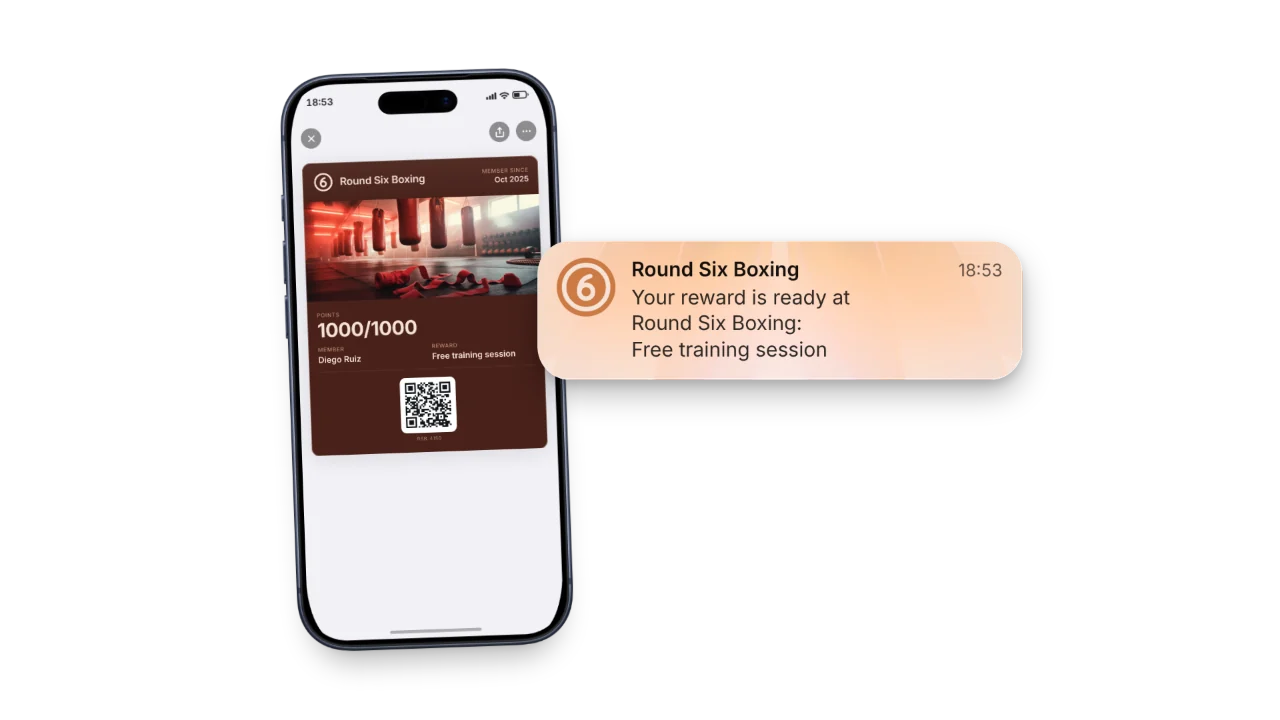
A loyalty pass lands in Apple Wallet, the visit is stamped and the reward notification arrives on the phone.
What should a gym reward if members already paid?
A gym is unlike every other vertical in one decisive way: the member has already paid. There is no purchased visit to reward. What you are rewarding is attendance itself, the twentieth session, the thirtieth, the regularity that turns a subscription from wasted money into a kept habit.
The reflex is to copy "ten visits, one free" from a coffee counter, and for a gym that is backwards. The member who comes ten times is coming anyway. The one who joined in January and has not appeared for three weeks is the one worth designing for.
So reward early and keep the next reward in sight. A smoothie at the fifth visit. A guest pass at the tenth. A session with a trainer at the twentieth, which ties the milestone to a jump in results.
There is a reason to keep rewards close together. The 2021 peer-reviewed study Predicting Fitness Centre Dropout, run over 5,209 members of a single fitness centre using records from June 2014 to October 2017, found that across every model tested the highest-ranked predictor of dropout was accumulated days of non-attendance. Not age, not price paid. A gap. A reward that is always within reach keeps the gap short, which is the thing the evidence says predicts leaving.
Stamps or points: which format fits my gym?
Three exist in practice, and for a gym the choice is usually quick.
| Format | Fits a gym when | Watch out for |
|---|---|---|
| Stamps, one per session | Almost always. A scan is a session, legible at a glance | Setting the goal so far out that nobody reaches it |
| Points | Class packages, a shop, a café, personal training sold separately | Members doing arithmetic to work out where they stand |
| Paper card | Never, at a turnstile | It is a second thing to carry past a door that is already busy |
Fideliya runs stamps and points, so the decision is yours rather than the tool's, and the goal is yours to place. On live Fideliya cards the most common stamp goal is 10, chosen by 8 of the 15 stamp cards in the September 2026 sample, with the rest spread between 5 and 15. In a gym, where a member may attend several times a week, a short goal reached quickly and repeated beats a long one nobody finishes; the reasoning is on how many stamps a loyalty card should have.
A pass that looks like your gym
The pass sits in the member's wallet beside their bank card and gets looked at before every session. It is a piece of the gym's identity, so it should carry your colours and your logo, and the session counter should be the clearest thing on it. That number is what the member opens the card to see.
Resist making it look like a game. A gym sells discipline and results; a progress bar drawn like a mobile game undercuts that. Legible, plain, and honest about where the member stands.
On Fideliya, logo, colours and reward wording are on every plan including the free one, the cover image comes with Pro at 49.99 euros a month, and a one-time 49.99 euro add-on, on either paid plan, removes the Fideliya badge for good. A pass you design on the Fideliya homepage carries straight into your account.
How do I get the pass onto members' phones?
The desk on the way in is the moment. The member is already stopping, already holding a phone or a fob. A QR code on the desk, a card by the turnstile, and one sentence from whoever is on shift: "We have a card that lives in your phone, no app." Then nothing more.
Joining asks for a name and an email address, with the phone number optional; there is no account and no password, and nothing to install. That matters at a door, where any extra step is a step taken while somebody waits behind. In the September 2026 Fideliya sample, 165 of the 186 holders ever scanned were scanned within an hour of joining, which is what enrolment at a counter looks like in the data, and the wallet split was 131 Apple to 124 Google, close enough to even that issuing only one platform would exclude about half the floor.
At the door, staff scan the member's code or type it, add the visit in one tap, and Undo takes back a scan made by mistake in the seconds after it. Plan the rollout around your shifts: Pro gives each person on the front desk their own login, with five team seats, and room for 2,500 members. What the free plan covers is set out on the free loyalty plan for a gym.
What should I measure in the first ninety days?
Three numbers, and the count of passes issued is not one of them.
Return inside the interval: what share of new holders come back within the gap that is normally theirs. Read it against your own first month rather than an industry figure, because your location, your price and your equipment are not in anyone else's average.
Attendance frequency among active holders: how often the engaged group actually turns up. Watch the direction rather than the level. A widening gap means something changed on the floor, in the timetable or at the door.
And the one that matters most, who has gone quiet: holders who were attending and have stopped. That is the list the dropout research says to look at, produced automatically, and each member's page shows where they stand and their next step. In Fideliya's September 2026 sample, 66 of the 186 holders ever scanned had not been back for 30 days or more, and 120 of the 255 cards had been active in the previous month. That sample is small and one restaurant account is 84 percent of it, so read the shape rather than the percentages.
For context on what the category as a whole looks like, the Health & Fitness Association's 2025 Fitness Industry Benchmarking Report, published 30 September 2025 from 175 companies and more than 17,000 facilities across 27 countries, puts average annual member retention at 66.4 percent, while its FIT Tracker of 15 January 2026 records more than 184,000 visits per location in 2025, up 4.2 percent, across nearly 11,000 facilities in its panel. Growth and churn run at the same time, which is why a gym can be adding members and still feel like it is standing still.
Sources
Health & Fitness Association, 2025 Fitness Industry Benchmarking Report, published 30 September 2025, based on 175 companies representing more than 17,000 facilities across 27 countries. Health & Fitness Association, FIT Tracker, published 15 January 2026, based on anonymised foot traffic across nearly 11,000 facilities in its panel, powered by Placer.ai. Sobreiro, Guedes-Carvalho, Santos, Pinheiro and Gonçalves, Predicting Fitness Centre Dropout, International Journal of Environmental Research and Public Health, 2021, 5,209 members of one fitness centre. All retrieved 5 September 2026. Own-data figures are Fideliya production aggregates measured on 4 September 2026 across external accounts: 255 enrolled cards, 186 ever scanned, 165 within an hour of joining, 131 Apple against 124 Google, 66 quiet for 30 days or more, 120 active in the previous 30 days, and 8 of 15 stamp cards on a goal of 10; one restaurant account is 84 percent of that sample. Plan prices, caps and feature gates are the published plans on the pricing page. This page carries no adoption-rate benchmark and no six-week or six-month churn figure, because none could be sourced.
Fideliya is wallet-native loyalty program software for small businesses. Customers add a stamp or points card to Apple Wallet or Google Wallet in one tap, with no app to download and no account to create. Fideliya runs stamps, points, gift cards and referrals on one platform in English, French, Spanish, Italian and Arabic with full right-to-left support, and the free plan issues a real wallet pass for up to 20 customers. What the product does for a gym is described on loyalty for gyms, and the plans are on the pricing page.