A restaurant loyalty rewards program turns the Friday first-timer who liked the meal into a regular, by making the second visit easier than the first. Diners scan the code on the bill presenter, give a name and an email, and the pass saves to Apple Wallet or Google Wallet: no app to download, no account or password to create. At every visit after that, one scan adds the stamp or the points.
Every restaurant has two covers at the same table most Tuesdays, and a first-timer who said they loved it and never came back. The difference is not the food. This page is the design: what the pass should count, where the goal goes, what staff say when they drop the bill, and what the first weeks look like.
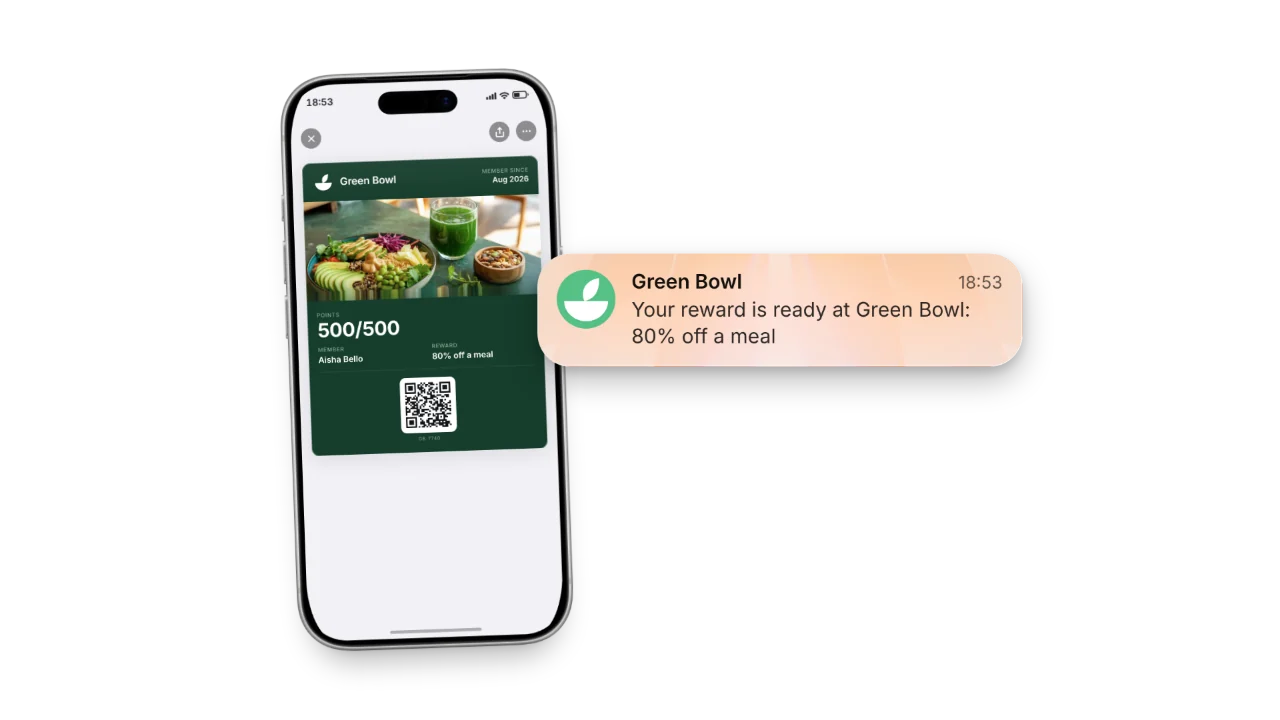
A loyalty pass lands in Apple Wallet, the visit is stamped and the reward notification arrives on the phone.
Should a restaurant loyalty program reward visits or spend?
Reward the visit. A spend-based program pays out fastest to the table of eight celebrating something, and that table was never going to become a regular; a visit-based program pays out to the person who comes for lunch most weeks, and that person is the entire argument for having a program at all.
Restaurant visits arrive unevenly, which is exactly why the rule has to be simple. A lunch trade and a dinner trade have different rhythms in the same room, and a pass that counts visits works in both without you having to model either. The behaviour worth encouraging is the return itself, at whatever interval your room actually produces, and counting it is the only version of that rule you can explain in one sentence at a table.
Stamps or points for a restaurant, and how many?
Stamps for a lunch trade, points where the bill genuinely swings. A neighbourhood restaurant with a set lunch and a full evening menu can see a bill move by a factor nobody wants to explain on a pass, and points handle that honestly by earning against value. A café-restaurant where most tickets look alike should stay on stamps, because a stamp needs no explanation and the pass reads itself.
The goal is a waiting time in disguise. Divide it by how often a regular actually eats with you and you have the weeks until the reward. A lunch regular reaches a goal of twelve inside a season; the same twelve for somebody who comes for a birthday is a promise measured in years, and it should be much shorter or the program is aimed at the wrong table.
Two things are worth saying about that number before you copy it. It is a design choice, and the only measured figure on this page is what other businesses picked. In Fideliya’s production data on 4 September 2026 there were fifteen live stamp cards, and their goals ran five on two cards, six on two, seven on one, ten on eight, twelve on one and fifteen on one, a median of ten. There were nine live points cards with a median goal of 750. The sample is small and concentrated, and that belongs in the same sentence: one restaurant is 84% of the wider holder sample those cards sit behind. Read it as what a handful of real businesses chose, never as a benchmark for yours. The same reasoning applied across fifteen trades is on fifteen punch card ideas.
A reward ladder that keeps them coming back
The distance a restaurant has to close is between visit one and visit two. Build the ladder for that gap, not for the loyal diner who was coming anyway.
- Give the first stamp at the table where they join. The pass should never be handed over empty.
- Put something on the second visit. An appetiser or a coffee, small enough to give without a discussion and early enough to matter.
- Put a middle rung where the habit forms. A dessert somewhere in the middle keeps a long goal from feeling long.
- Keep the named reward at the goal. A main course, or whatever the pass promises, stays at the end.
- Price the whole ladder against the covers it takes to earn. Not against the menu price of the item you are giving away.
The line to say when you drop the bill
It is said once, at the bill, and it has to be shorter than the pause while the card machine thinks:
“We’ve got a loyalty pass if you’d like it. It’s free, it goes on your phone, and it starts today.”
Three clauses, each removing an objection: no cost, no app, no empty pass. Say it while handing over the bill presenter with the code facing them, and then stop talking. The failure mode here is a server explaining a rewards structure to a table that has already decided; the code does the explaining, and the first stamp does the persuading.
The scan itself stays quick: point the phone at the code or type it, add the stamp or the points in one tap, and Undo takes back a scan made by mistake in the seconds after it.
Set it up in seven days
Seven days, and the middle three are the ones restaurants skip.
| Day | What you do | Why it is that day |
|---|---|---|
| Day 1 | Decide visits or spend, the goal and the reward | Change this later and you move the finish line for everyone |
| Day 2 | Design the pass and print bill-presenter codes | The bill is where the phone already is |
| Day 3 | Enrol the floor team and scan each other | Servers who have used it will offer it |
| Day 4 | Agree the one sentence at pre-service briefing | A script agreed once is a script said the same way |
| Day 5 | Run it on a full service, not a quiet one | You want the awkward version early |
| Day 6 | Put the same code in takeaway and delivery bags | It is the only way a platform order becomes yours |
| Day 7 | Read the funnel and count second visits | Enrolments are the easy half |
None of the seven days needs a full morning, and the seventh is the one that decides whether week two is worth planning. The step-by-step version, written for the counter rather than for the design, is on how to create a restaurant loyalty program.
Know who’s due back before you lose them
Three numbers do the work, and they already have names on the dashboard. Returning counts the diners with two or more visits in the period, set against the period before, and it is the only honest test of whether the program changed anything. The funnel follows the same people from holding your pass to visiting, coming back, earning a reward and redeeming it, which is the difference between a pass people take and a pass people use. And Due back, on the Overview, counts everyone with no visit in over 30 days, names them, and puts Send them a message one tap away.
Due back opens the same people on your Customers page, under its Inactive filter, so the count and the list always agree. On Pro, Analytics also sorts your customers into New, Regulars, Due back and Lost, and Lost is anyone with no visit in 90 days or more. Check the funnel and Due back on the same day each month. A pass that fills on a busy Friday and never gets scanned again told you something, and it told you early.
When Due back fills, you can reach exactly those people. A Fideliya broadcast is addressed: to everyone holding that pass, to the customers seen in the last 30 days, to those not seen for over 30, or to named individuals. Every message is yours: you pick who gets it and when it goes out, now or scheduled.
Win back the diners who liked it, and the delivery orders
The pass brings back the diners who liked the meal and simply did not think about coming back. A table that left unhappy is a kitchen or service question, and that one stays yours to fix.
Delivery orders can become yours too: put the code in the bag, and the pass that gets added belongs to the restaurant rather than the platform. Everything else about that trade-off sits on why restaurants replace stamp cards.
Sources
Search Console recorded the query "restaurant loyalty" at 94 impressions and average position 66.7 in the three months to 1 September 2026, which is the demand this page is written against; the figure lives in the source note rather than in the prose. The goal distribution is Fideliya production data measured on 4 September 2026 across external accounts, with its sample size and concentration caveat stated beside it. Every plan limit and product behaviour named above is cited to the file that implements it in the source note on this article. The suggested goal and the ladder are design choices for this page, not measurements, and this page quotes no third-party statistic.
What a restaurant loyalty program costs
Fideliya is wallet-native loyalty program software for venues with a counter. Customers add a stamp or points pass to Apple Wallet or Google Wallet in one tap, with no app to download and no account to create. Fideliya runs stamps, points, gift cards and referrals on one platform in English, French, Spanish, Italian and Arabic with full right-to-left support. The pass and the scanner are on the free plan, which carries twenty customers at one location. Pro, at €49.99 a month, is the plan a restaurant reaches quickly, because it opens five team seats and 2,500 customers, and a program only one manager can run is a program that stops on their day off. Set that against one Tuesday lunch regular gained. What the product does at the counter is described on the restaurant loyalty program, and the plans are on the pricing page.
The first 14 days
- Day 1: print the QR code and put it by the till.
- At every payment, offer the pass: "Want the pass? One scan and it's done."
- Your team scans the pass at every visit.
- By day 14, you know who your regulars are.
Start your 14 days free. No card. If your regulars don't join, you pay nothing.