Move your restaurant's stamp card into Apple Wallet and Google Wallet and you finally know who is in your full room, and who stopped coming. The record moves to your side, so a regular's absence becomes a name on a list rather than an empty table nobody notices.
The tenth-meal coupon, the dessert voucher, the card punched at the end of the bill: they work well enough that nobody questions them. The real problem was never the paper. It is that a restaurant with a full room cannot tell you who is in it.
This page is about what changes when that coupon moves into Apple Wallet and Google Wallet: what the paper actually costs, what the pass records instead, what our own cards show, and what the switch costs.
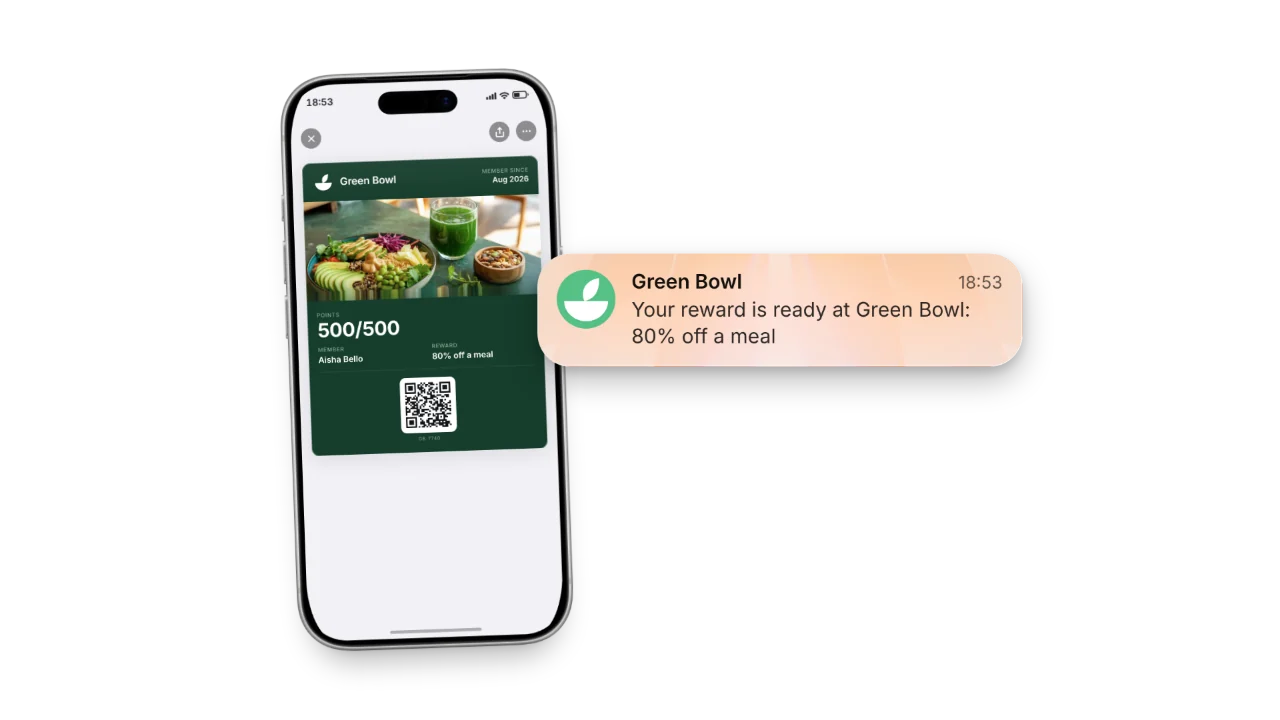
A loyalty pass lands in Apple Wallet, the visit is stamped and the reward notification arrives on the phone.
Why can't a restaurant name its regulars?
A full restaurant holds two kinds of customer: the one who comes back every fortnight, and the one who passed through once on the way to the cinema. The day's takings do not distinguish them. The till does not distinguish them. The paper coupon does not either.
What that costs is the thing a loyalty programme exists to prevent. The regular who stops coming sends no notice. Their table is taken by somebody else the following week, and nobody registers that a frequency dropped. By the time a familiar face has been absent long enough to be noticed, the habit has usually moved.
What a wallet pass gives your restaurant
A wallet pass is the same format the customer already uses for a boarding card and a concert ticket. It lives in the phone next to the bank card. It is not left at home, it updates itself, and, more to the point, it returns data to the restaurant.
| Question | Paper coupon | Fideliya wallet pass |
|---|---|---|
| Where does it live? | The bill folder, a coat, a bin | Apple Wallet or Google Wallet |
| What records a visit? | A punch, if the card is present | A scan of the pass at the table or the till |
| What if it is lost? | The visits go with it | The count is on the account, the pass is re-added |
| Who holds the record? | The customer | The customer and the restaurant |
| Who has stopped coming? | Not answerable | Listed in the dashboard |
| Menu or offer changes | Reprint the batch | Edit the pass |
| Cost to start | Printing, per batch | 0 euros on the Fideliya free plan, 20 customers |
The pass also speaks. When a new menu lands, or a Tuesday is quiet, a short relevant message reaches the holder's phone. That is the part a coupon could never do, and it is the part worth rationing: Fideliya includes one broadcast a month on the free plan and three a month on Pro, and that ceiling is the recommendation rather than an obstacle. Write the message when you have a quiet minute and schedule it up to 30 days ahead, for the Tuesday you want to fill.
What Fideliya's own cards show
These are Fideliya production aggregates measured on 4 September 2026 across external accounts. The sample is 255 enrolled cards, and one restaurant account is 213 of them, 84 percent, plus 237 of the 281 scans. On any other page that concentration would be a caveat. On this one it is worth naming precisely: this is a poor industry benchmark and an unusually direct look at what one restaurant's wallet card actually did.
- 165 of the 186 holders ever scanned were scanned within an hour of joining, which is 89 percent. Enrolment happens at the table, not later at home.
- The wallet split was 131 Apple to 124 Google across 255 holders, close to even.
- 66 of the 186 had gone quiet for 30 days or more, and 120 of the 255 cards were active in the previous month. That first list is what the coupon never produced.
- Ten is the common stamp goal: 8 of the 15 live stamp cards use it, the rest spread between 5 and 15.
The last one is worth a caution in a restaurant specifically. A ten-visit cycle that works at a coffee counter is a long wait for a main course, so the useful move is to put something smaller at visit two or three and keep the goal at the end. The reasoning is set out on how many stamps a loyalty card should have.
Joining at the table, with nothing to install
The coupon is handed over after the bill. The customer keeps it, loses it, or leaves it between the receipt and the tip. To redeem it they have to remember to bring it, find it, and present it at the right moment. Most do not.
The pass is added by scanning a QR code on the bill folder. There is nothing to take home, because the phone comes back with the customer anyway. To redeem, a server scans from a phone or a tablet; the Fideliya scanner runs in a browser, so there is no terminal to buy and no staff app to install. The server scans the code or types it, adds the stamp or the points in one tap, and Undo reverses a mistaken scan in the seconds after it.
Joining asks for a name and an email address, with a phone number optional. No account, no password, no download. An app would be the alternative, and an app has to survive being installed: AppsFlyer's 2025 App Uninstall Report, covering 2.2 thousand apps and 1.3 billion installs across the top 40 markets, puts 46.1 percent of installs uninstalled within 30 days in 2024, measured on Android because iOS uninstall tracking is limited after iOS 15. The comparison is on loyalty app or wallet pass.
How do I switch from paper coupons?
It is not a project. It is a QR code in the bill folder and one sentence for the floor team, said while handing back the card machine: "We have a regulars' card, it goes in your phone, nothing to install." Coupons already issued stay valid until they are redeemed, so nobody is cut off, and from day one new customers get the pass instead.
The Fideliya free plan is 0 euros and carries 20 customers at one location with a real wallet pass, the browser-based scanner and all five interface languages, with no card details. Twenty is enough to find out whether the floor says the sentence, which is where every programme fails first. Pro at 49.99 euros a month, or 39.99 euros billed yearly, carries 2,500 customers, four locations, five team seats, gift cards, referrals and a CSV export of the customer list.
The paper coupon is not broken. It simply lives in a world where the customer stopped carrying paper, and the wallet the customer does carry has been digital for years. The bakery version of this argument, with the same figures, is on why bakeries replace stamp cards, and the order to build the programme in is on how to create a loyalty program for a restaurant.
Sources
Own-data figures are Fideliya production aggregates measured on 4 September 2026 across external accounts: 255 enrolled cards, 186 ever scanned, 165 of those within an hour, 131 Apple against 124 Google, 66 quiet for 30 days or more, 120 active in the previous 30 days, and 8 of 15 stamp cards on a goal of 10. One restaurant account is 213 of the 255 cards and 237 of the 281 scans. AppsFlyer, App Uninstall Report, 2025 edition, covering 2.2 thousand apps and 1.3 billion installs across the top 40 markets, Android only, retrieved 4 September 2026. Plan prices, caps and broadcast allowances are the published plans on the pricing page. This page carries no printing-cost figure and no payback period, because neither could be sourced.
Fideliya is wallet-native loyalty program software for small businesses. Customers add a stamp or points card to Apple Wallet or Google Wallet in one tap, with no app to download and no account to create. Fideliya runs stamps, points, gift cards and referrals on one platform in English, French, Spanish, Italian and Arabic with full right-to-left support, and the free plan issues a real wallet pass for up to 20 customers. What the product does in a dining room is described on loyalty for restaurants, and the plans are on the pricing page.