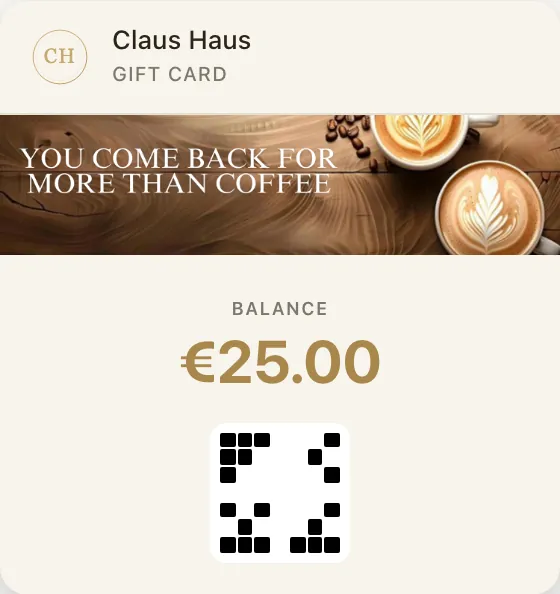
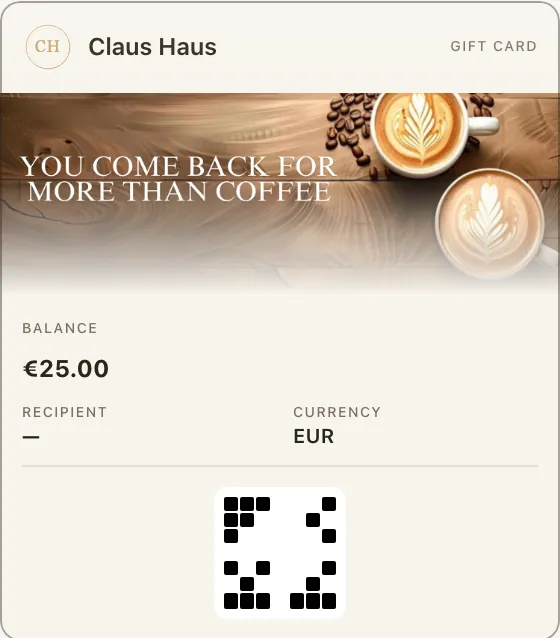
A Fideliya gift card brings people to your counter, because it lives on their phone instead of in a drawer. It is a real wallet pass: it arrives by email, the recipient adds it in one tap, and the balance sits on the front, next to your loyalty card. Staff scan it at the counter to take a purchase off. One design on Pro, unlimited on Enterprise.
Gift cards that bring people to your counter: a wallet pass sent by email, added in one tap, spent by scanning, with the balance always on their phone.
A gift card nobody leaves in a drawer
In their wallet in one tap
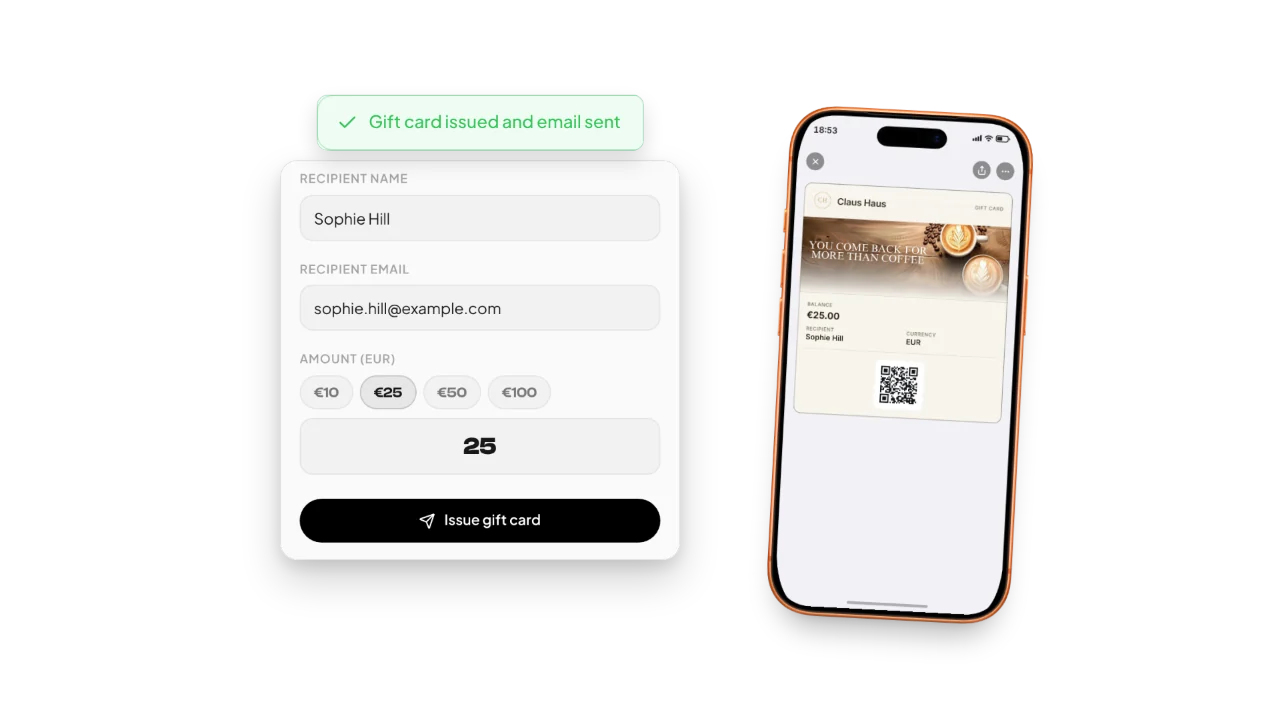
Fideliya emails a claim link; they choose Apple Wallet or Google Wallet, and the card is on the phone they already hold.
The balance is always in sight
It sits next to your loyalty card, so they see it every time they open the wallet to collect a stamp.
Spent with the scanner you already use
Staff scan it, type the amount, and the balance drops on the recipient’s phone. Who scanned, where, and the balance after are recorded.
Your design, your currency
Your name, logo, cover image and colours, in euros, dirhams or riyals. One design on Pro, unlimited on Enterprise, seasonal ones included.
No surprises at the till
Ask for more than the balance and Fideliya refuses the deduction and shows what is left. It never quietly takes the card to zero.
Somebody buys a gift card for a friend on a Tuesday. On Saturday the friend is standing at your counter with a phone in her hand, and the card is right there, under the stamp card she already has from you, balance printed on the front. Nothing to find in an inbox. Nothing left at home in a coat pocket.
A paper voucher has two ways to fail: the buyer forgets to hand it over, or the recipient forgets to bring it. A card in the wallet has neither, and it does something a voucher never could. It sits next to the loyalty card, so every time your customer opens the wallet to collect a stamp, they see money they have already spent with you and have not used yet.
From purchase to the counter
You issue the card from the dashboard: pick a template, type the amount and the recipient’s email, and Fideliya sends a claim link. The recipient opens it, chooses Apple Wallet or Google Wallet, and the card is saved with the balance on the front. No app to download, no account to create, the same rule every Fideliya pass follows.
At the counter the recipient shows the card, and a member of staff scans it with the Fideliya scanner in the browser of whatever phone or tablet they carry. They type the amount of the purchase, Fideliya takes it off, and the balance updates on the recipient’s phone. Every deduction records the amount, the balance after, the staff member who scanned and the location.
What the card carries
A template is the design, kept under your own name: the business name, a logo, an optional cover image, and the background, text and accent colours. Each card issued from it carries its own amount, its own balance, and the language it was issued in, so a card sent to a French-speaking recipient reads in French even when the next one goes out in English.
| Field | Where it comes from |
|---|---|
| Business name, logo, cover image, colours | The gift card template |
| Amount and currency | Set at issue; euros, Moroccan dirhams, UAE dirhams or Qatari riyals |
| Balance | Updated on the phone after every deduction |
| Language | Stamped on the card when it is issued |
| Wallet | Apple Wallet or Google Wallet, chosen by the recipient at claim |
Which plan includes gift cards
Gift cards start on Pro. Fideliya includes one template on Pro at 49.99 euros a month and unlimited templates on Enterprise from 99.99 euros a month; the Free plan has none. One template covers a standard card in your colours. Unlimited lets you keep the standard one and add a winter card and a summer card without retiring it.
| Plan | Gift card templates | Monthly price |
|---|---|---|
| Free | 0 | 0 euros |
| Pro | 1 | 49.99 euros |
| Enterprise | Unlimited | from 99.99 euros |
The refusal that makes it trustworthy
Ask Fideliya to take fifteen euros off a card holding nine, and it refuses. It does not take the card to zero and call it done, and it does not silently deduct what it can. It stops, tells staff the balance in their own language, and lets them take the difference another way.
That distinction is the whole trust argument for a prepaid card. Software that clamps a deduction to the balance is software that quietly disagrees with the customer about how much money they had, and the customer finds out later, alone, looking at a card that says zero. Refusing is louder in the moment and correct forever afterwards. It is the only refusal a gift card scan can produce; Fideliya never refuses a scan for coming too soon after the last one, because a queue cannot wait on software forming an opinion about a tap.
Every deduction lands in the dashboard’s activity, and the customer’s own record shows the gift cards they hold beside any loyalty card from you. A recipient who was never a loyalty customer becomes visible the moment they claim a card.
A second product that shares a wallet
Fideliya keeps gift cards separate from loyalty on purpose. A gift card has its own templates, its own currency check, and its own claim and deduct flow. It adds no stamps and does not sit inside a loyalty pass. That separation is what lets a florist who runs no loyalty program at all sell wallet gift cards before Mother’s Day and nothing else. A business that does run loyalty gets both products in the same wallet, scanned by the same staff with the same scanner.
Why the wallet beats plastic
A plastic gift card costs money to print, sits in a drawer, and shows its balance only when somebody asks the till. A wallet gift card costs nothing to issue, is on the recipient’s phone within a minute of purchase, and shows its balance every time they open the wallet. It cannot be lost, and you see every card issued, every balance outstanding and every deduction in one place.
Fideliya is wallet-native loyalty program software for small businesses. Customers add a stamp or points card to Apple Wallet or Google Wallet in one tap, with no app to download and no account to create. Fideliya runs stamps, points, gift cards and referrals on one platform in English, French, Spanish, Italian and Arabic with full right-to-left support, and the free plan issues a real wallet pass for up to 20 customers. Gift cards begin on the Pro plan; the full comparison is on the pricing page.
Simple, transparent pricing
Turn visitors into regulars. Start free.
Free
€0.00/ month
1 business · 1 active pass · 20 customers
Pro
€49.99/ month
1 business · 1 active pass · 2,500 customers · 4 locations
Enterprise
€99.99/ month
1 business included, up to 5 · 1 active pass each · Unlimited customers · Unlimited locations
- No credit card required
- Cancel anytime
Frequently asked questions
Pick a template, type the amount and the recipient’s email, and Fideliya sends a claim link. The recipient opens it and adds the card to Apple Wallet or Google Wallet in one tap.
They show the card in their wallet. Staff scan it with the Fideliya browser scanner, type the purchase amount, and the balance drops on the recipient’s phone.
Gift cards begin on Pro, with one gift card template. Enterprise includes unlimited templates. The Free plan does not include gift cards.
Yes. A template is denominated in euros, Moroccan dirhams, UAE dirhams or Qatari riyals, and every card issued from it carries that currency.
Fideliya refuses the deduction and shows staff what is left, so they can take the difference another way. It never clamps the card to zero, and that is the only refusal a gift card scan can produce.
No. Gift cards are a second product that shares the wallet, so a business with no stamps or points can sell a wallet gift card on its own.
No. A Fideliya gift card is a native wallet pass. The recipient opens the claim link and saves it to the wallet already on their phone.
Yes. Fideliya lists every card you have issued with its balance, and every deduction records the amount, the balance after, who scanned it and at which location.
Ready to get started?
No card. If your regulars don't join, you pay nothing.
Related articles
More Regulars: Small Business Loyalty Guide
Turn one-time customers into regulars with a small business loyalty program that works: the right reward, the right card, and a launch this afternoon.
Loyalty program cost in 2026: start at €0
Start a digital loyalty program at €0 and pay a flat monthly fee only once it grows. What a small business really pays, line by line, hidden fees included.
Win Regulars: Your Boutique Loyalty Program
A boutique loyalty program that brings clients back for recognition, not discounts: early access, store credit and a pass that reads as membership.