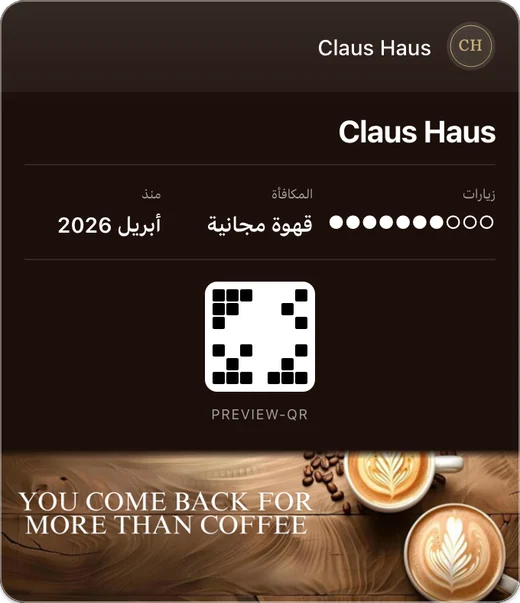
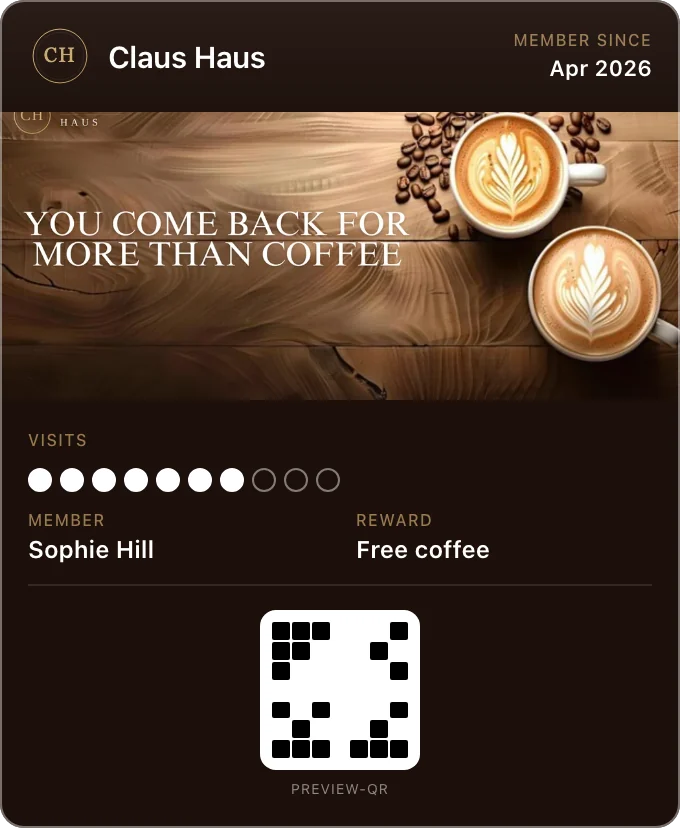
Fideliya speaks five languages, English, French, Spanish, Italian and Arabic, so your customers read your card the way they read everything else. You pick the language when you design your pass, and the wallet card, the join page and the notifications all read in it. The dashboard is in all five on every plan, and Arabic is laid out right-to-left, not poured into a left-to-right screen.
Speak to every customer in their language: your card, join page, notifications and dashboard in English, French, Spanish, Italian or Arabic.
Every customer at home with your card
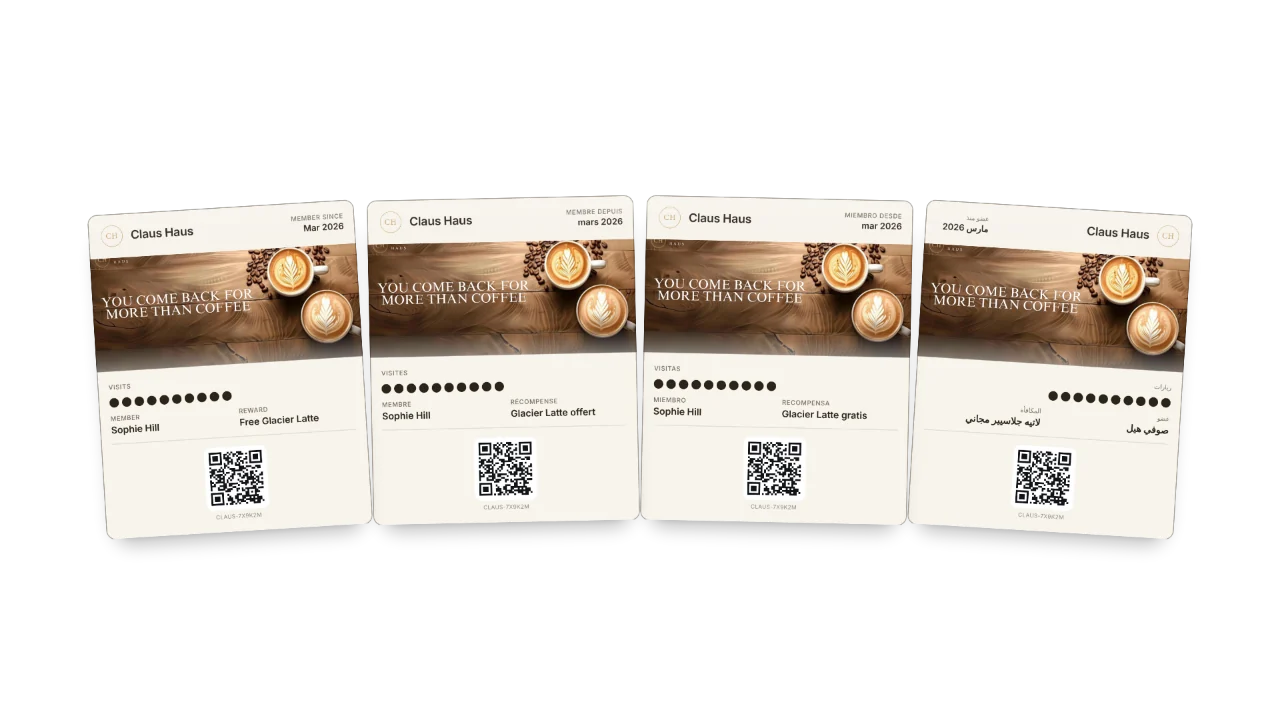
Five languages, Italian included, on every plan
English, French, Spanish, Italian and Arabic, across the wallet card, the join page, the notifications and the dashboard. Nothing extra to pay.
Your card speaks your customers’ language
You pick the language when you design the pass; every label on it, member since, reward, next reward, follows, in Apple Wallet and Google Wallet.
Arabic that reads right
The dashboard, the join page and the card all lay out right-to-left. No right-aligned button stranded in a left-to-right screen.
Gift cards in the recipient’s language
A gift card carries the language it was issued in, so a card sent to a French speaker stays French even when the next one goes out in English.
Your team works in its own language
One card, one language you choose, and changing it updates every card at once. Each staff member reads the dashboard in their own.
A customer opens your card in her wallet and everything on it is in her language. Not most of it. The label above the stamps, the name of the reward, the line that says when she joined, and the little message that appeared on her lock screen this morning.
A card somebody cannot read is a card they do not use. Fideliya runs in English, French, Spanish, Italian and Arabic, and it treats the fifth as a first language rather than a translation: Arabic is laid out right-to-left, on the card, on the page your customer joins from, and in the dashboard you run it from.
What is in which language
There are four surfaces a customer or an owner reads, and Fideliya covers each of them in all five languages. The wallet card carries labels, member since, reward, next reward, the welcome message, and each is rendered in the language chosen for that card. The join page a customer lands on from a QR code or a link is in the same language. Wallet notifications, the short message a phone shows when a stamp is added or a reward is earned, are built in the language of the pass they belong to. And the dashboard, where the owner designs the card, reads the analytics and runs the scanner, is in all five languages too.
| Surface | Languages | Who chooses |
|---|---|---|
| The wallet card (labels, reward, member since) | English, French, Spanish, Italian, Arabic | The business |
| The join page | English, French, Spanish, Italian, Arabic | Follows the pass |
| Wallet notifications | English, French, Spanish, Italian, Arabic | Follows the pass |
| Gift cards | English, French, Spanish, Italian, Arabic | Set when the card is issued |
| The dashboard and the scanner | English, French, Spanish, Italian, Arabic | Each staff member |
Choosing the language of a card
The business chooses the language when it designs its loyalty pass, and that one choice covers the whole program. Fideliya runs one active pass per business, so there is one card, in one language, and every customer who joins holds the same one. A café whose regulars read both Arabic and French picks the language most of them read. It is worth deciding deliberately rather than leaving on the default, because changing it later changes the card in every wallet that already holds it.
Because the language is a property of the card, it does not depend on the phone’s settings. A customer who keeps an English phone gets the card in the language the business chose, and it stays in that language wherever the phone goes.
What right-to-left means in practice
Arabic reads from right to left, and a product that supports it has to lay itself out that way: text aligned to the right, lists and progress reading from the right, navigation mirrored, numbers and Latin names kept as islands inside the flow. Fideliya does this across the product. The dashboard mirrors when the owner’s language is Arabic. The join page mirrors for an Arabic card. On the wallet card itself, the labels are Arabic and the card’s fields are ordered for an Arabic reader, so member since and reward sit where an Arabic eye expects them.
The difference between this and a translated left-to-right screen is the difference between a product that was built for the language and one that was run through a dictionary. A right-aligned button in a left-to-right layout is the tell, and Fideliya was built not to have it.
The team reads in its own language too
Every staff member who logs in to Fideliya sees the dashboard and the scanner in their own language, chosen on their account. An owner who runs the business in French and a member of staff who scans in Arabic each see their own language at their own counter, on the same plan, with no configuration beyond each person’s setting.
Which plan includes the five languages
All of them. Fideliya includes English, French, Spanish, Italian and Arabic on the Free plan, which issues a real wallet pass for up to 20 customers at no cost. Language is not a feature to pay for; it is the condition for the card being read at all.
Fideliya is wallet-native loyalty program software for small businesses. Customers add a stamp or points card to Apple Wallet or Google Wallet in one tap, with no app to download and no account to create. Fideliya runs stamps, points, gift cards and referrals on one platform in English, French, Spanish, Italian and Arabic with full right-to-left support, and the free plan issues a real wallet pass for up to 20 customers. The plans are on the pricing page.
Simple, transparent pricing
Turn visitors into regulars. Start free.
Free
€0.00/ month
1 business · 1 active pass · 20 customers
Pro
€49.99/ month
1 business · 1 active pass · 2,500 customers · 4 locations
Enterprise
€99.99/ month
1 business included, up to 5 · 1 active pass each · Unlimited customers · Unlimited locations
- No credit card required
- Cancel anytime
Frequently asked questions
English, French, Spanish, Italian and Arabic. Fideliya renders the wallet card, the join page, the notifications and the dashboard in all five.
Yes. Fideliya lays Arabic out right-to-left on the card, on the join page and in the dashboard, rather than placing Arabic text in a left-to-right layout.
The business, when it designs the card, and it can change it later in the card’s settings. Fideliya runs one active pass per business and re-renders every holder’s card when the language changes, so every customer holds the card in the language the business chose.
Gift cards can, because each is stamped with the language it was issued in, and staff each read the dashboard in their own. The loyalty card carries the one language the business chose, the same card for every customer, and changing it updates every card at once.
Yes. Fideliya builds the short wallet message a customer receives when a stamp is added or a reward is earned in the language of the pass, so the notification reads the way the card does.
Yes. Fideliya’s dashboard and scanner are in English, French, Spanish, Italian and Arabic, chosen per staff account, and the Arabic dashboard is laid out right-to-left.
Yes. A Fideliya gift card carries the language it was issued in, so a card sent to a Spanish speaker stays Spanish whatever language the next card goes out in.
No. Fideliya includes all five languages on every plan, including the Free plan, which issues a real wallet pass for up to 20 customers.
Ready to get started?
No card. If your regulars don't join, you pay nothing.
Compare with other loyalty platforms
Related articles
More Regulars: Apple & Google Wallet Loyalty
Apple Wallet and Google Wallet loyalty cards bring your customers back, with no app to download. What they see, what staff do, how to launch in an hour.
More Regulars: Small Business Loyalty Guide
Turn one-time customers into regulars with a small business loyalty program that works: the right reward, the right card, and a launch this afternoon.
More Regulars: Restaurant Loyalty Program
Bring diners back without coupons, apps or commissions: a restaurant loyalty program with early rewards, a wallet pass, and three numbers to watch.